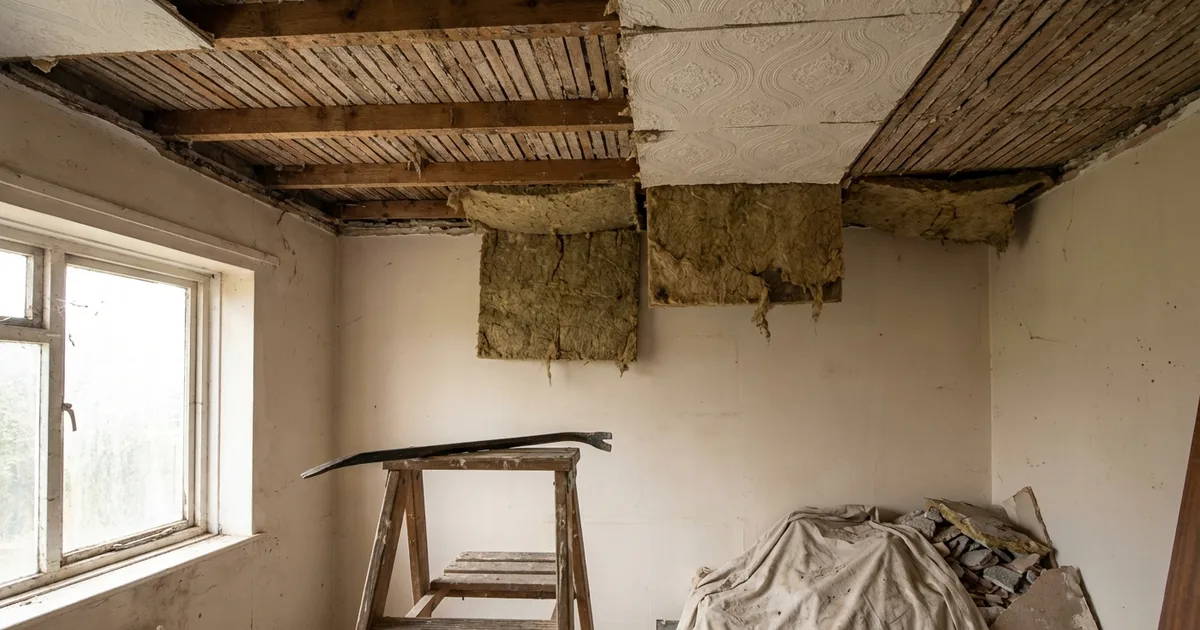
You’ve just knocked a hole in the ceiling, or you’re about to, and now you’re staring at the material above your head wondering whether it’s something you should be worried about. Maybe it’s a swirly Artex coating in your spare bedroom. Maybe it’s the crumbling edge of a garage roof panel you’ve ignored for years. Whatever triggered the question, here’s the first thing you need to know: you cannot identify asbestos by sight.
No amount of Googling images will give you a definitive answer. But you can assess your risk level. For most homeowners in pre-2000 UK properties, a systematic room-by-room check takes about 20 minutes and tells you whether you need professional testing before you pick up a single tool.
This guide gives you a practical framework: property age, material type, and condition. Those three factors, applied room by room, will tell you where the risks are and exactly what to do next.
Why You Can’t Identify Asbestos by Sight
If you’ve searched “what does asbestos look like,” you’ve already hit the fundamental problem. Asbestos fibres are microscopic. Two materials can look identical under every condition, and one contains asbestos while the other doesn’t. The only way to confirm the presence of asbestos is laboratory testing of a sample by a UKAS-accredited laboratory. No visual inspection, no matter how experienced the person, can replace that test.
Do not take samples yourself. Professional surveyors use proper PPE and containment procedures to prevent fibre release during sampling. A badly taken sample creates the exact exposure you’re trying to avoid.
What you can do without a lab is narrow the field. The age of your property, the type of material, where it’s located, and its current condition all point towards a risk level. That risk level tells you whether testing is warranted or whether the material can be safely managed in place.
Over 6 million UK homes built before 2000 contain asbestos-containing materials (ACMs). In domestic properties that have been formally surveyed, 86% were found to contain some form of ACM, with an average of almost 5 occurrences per property. If your home was built before 2000, the odds are strongly in favour of asbestos being present somewhere. The danger comes from disturbance: drilling, sanding, cutting, scraping, or breaking.
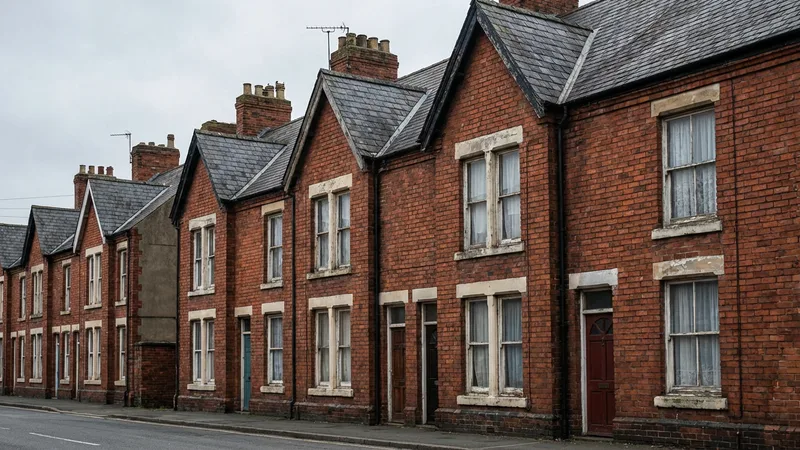
Start Here: How Old Is Your Property?
Property age is the single most important factor in assessing asbestos risk. It determines which materials were in use during construction and therefore which rooms you should scrutinise most closely.
| Build Period | Risk Level | Recommended Action |
|---|---|---|
| Built after 2000 | Extremely low | Asbestos was fully banned in the UK in November 1999. No further action needed unless older materials were reused in construction. |
| Built or refurbished 1985–1999 | Moderate | White asbestos (chrysotile) was still in use. Risk exists in textured coatings, floor tiles, and roofing materials. Commission a survey before any renovation work. |
| Built or refurbished before 1985 | High | Blue (crocidolite) and brown (amosite) asbestos were still legal until 1985. Treat any suspect material as containing asbestos until tested. |
Pay close attention to the word “refurbished.” A 1970s house with a 1980s kitchen extension carries risk in both the original build and the extension. A 1930s semi with a 1990s loft conversion could have chrysotile in the newer work. White asbestos (chrysotile) was the last type banned, in November 1999. Check the original construction and any major works that followed.
With your risk level in mind, work through each area of your property below. Focus on the highest-risk rooms first.
How to Identify Asbestos Room by Room
Living Room
Start by looking up. Asbestos ceilings are one of the most common ACMs in UK homes. If your living room has a textured coating with swirled, stippled, or patterned finishes, it was almost certainly applied between the 1960s and 1980s. These Artex-style coatings frequently contained chrysotile asbestos. You cannot confirm this visually. If your property was built before 1985, assume risk and do not sand, scrape, or drill into the surface. Our guide on whether Artex contains asbestos covers this in more detail. The same caution applies to textured wall coverings: some pre-1980 papers used asbestos fibre, and the backing layer or paste under woodchip and Anaglypta can contain it regardless of the face paper — see our asbestos wallpaper guide before stripping or sanding.
Suspended ceiling tiles (12”×12” or 24”×24”) with a fibrous or granular texture are another common find, particularly in 1960s to 1980s builds. Board panels around fireplaces and wood burners may be Asbestos Insulating Board (AIB), a higher-risk, more friable material than asbestos cement. Decorative hardboard-style wall panels in 1960s and 1970s homes can also be AIB.
Kitchen
Old vinyl floor tiles are one of the most frequently encountered ACMs in UK kitchens. The key identifier is size: asbestos floor tiles were manufactured in imperial dimensions, typically 9”×9”. But the real risk often lies underneath. The black mastic adhesive used to bond these tiles to the subfloor was itself an asbestos-containing product. Do not scrape or lift old floor tiles without testing both the tile and the adhesive.
Ceiling tiles are very common in kitchens from the 1960s to 1980s. Soffit boards under kitchen units and cupboard kick-plates in older builds may also contain asbestos. Check behind and under appliances connected to the boiler for pipe lagging, which typically appears as white or grey wrapped material around hot water pipes.
Bathroom
Ceiling tiles in bathrooms were popular because asbestos cement and AIB provided excellent moisture resistance. The same vinyl flooring risk applies here as in the kitchen, particularly 9”×9” tiles and the adhesive beneath them.
Pipe lagging is common around hot water pipes feeding the bath or sink, and in boiler cupboards. In older properties with steel-framed windows, the putty or glazing compound around the frames may also contain asbestos. If you’re planning to replace windows in a pre-1980s bathroom, get the compound tested first.
Bedroom
Textured ceilings are the primary concern here. Artex and similar coatings were applied in bedrooms just as commonly as in living rooms during the 1960s to 1980s. The same rule applies: do not sand, scrape, or drill into textured coatings in pre-1985 properties without testing first.
A less obvious risk sits inside older fitted wardrobes. The panels lining built-in wardrobes in 1950s to 1970s properties may be AIB. If you’re removing or modifying built-in storage in an older home, check the board material before cutting into it. Ceiling tiles appear in some bedrooms too, though less commonly than in kitchens and bathrooms.
Loft and Attic
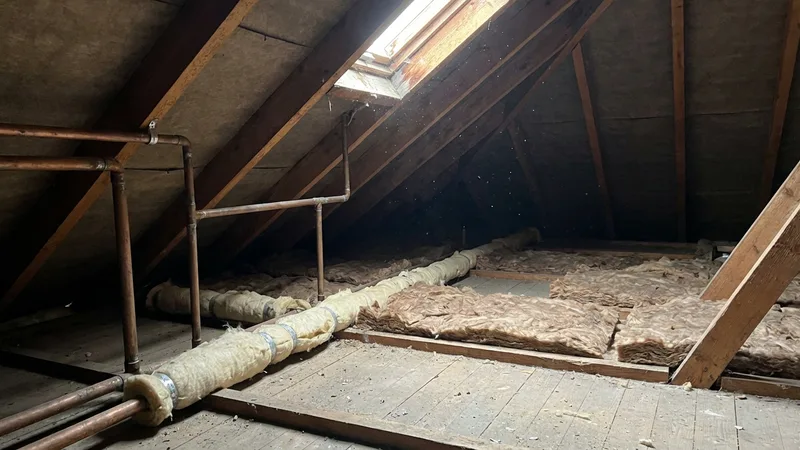
The loft is often the highest-risk area in the house. It frequently contains multiple ACMs, including the most dangerous form of domestic asbestos.
Loose-fill insulation deserves its own warning. It appears as loose blue, grey, or white granules spread between joists. Do not confuse it with glass fibre wool, which is fluffy and typically yellow or pink. Loose-fill asbestos insulation is one of the most hazardous ACMs you can encounter in a residential property. It is extremely friable, meaning the lightest disturbance sends fibres airborne. If you find granular material in your loft that isn’t standard fibreglass, do not touch it, do not walk on it, and leave the loft immediately. This is a job for an HSE-licensed contractor with full containment equipment.
Pipe and tank lagging around cold water tanks, header tanks, and loft pipes is also common. Look for white or grey wrapped material around pipes. Roof boards and felt visible under tiles in older properties may also contain asbestos.
Hallways and Stairs
Old thermoplastic floor tiles (pre-1980) are common in hallways, along with the black adhesive used to bond them to the subfloor. The same mastic risk applies here as in the kitchen. If the tiles are 9”×9” and the adhesive underneath is black, treat both as suspect.
Stair nosing strips, the protective edging on each step, sometimes contained asbestos for fire resistance. Textured ceiling coatings were commonly applied in hallways and stairwells, following the same Artex pattern as other rooms.
Garage and Outbuildings
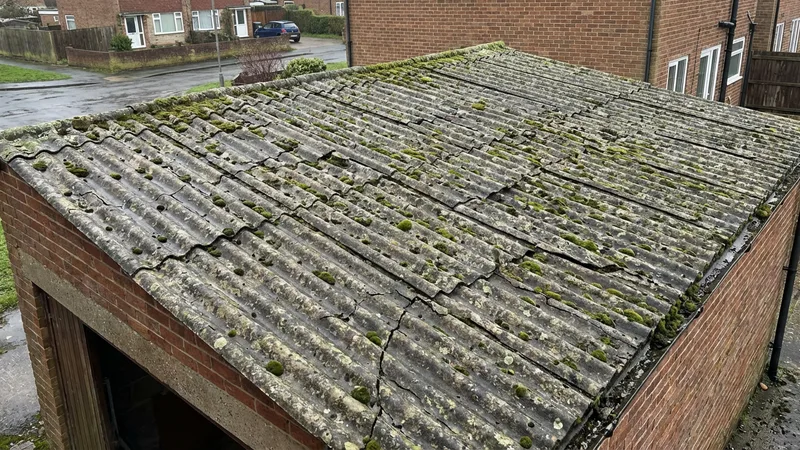
This is the most commonly encountered asbestos in UK residential properties, and often the most visible. Corrugated cement roof sheets on garages, sheds, and outbuildings are a standard feature of pre-1990s UK housing. These grey, corrugated panels gather moss and develop cracks or chips with age. One useful heuristic: asbestos cement tends to snap cleanly rather than crumble like standard concrete.
Up to 4.9 million UK homes may have asbestos in garage roofs specifically. If yours is showing signs of wear, cracking, or deterioration, read our guide on asbestos garage roof removal before doing anything with it.
Also check soffit boards under the eaves, any internal partition walls within the garage (some were built with asbestos cement board), and older flue pipes and guttering. These tend to have a grey, chalky appearance. The HSE’s asbestos location guide has a full visual reference for each material type.
What Not to Do — The Actions That Turn a Low Risk Into a Real One
Undisturbed asbestos in good condition is not a health emergency. Disturbed asbestos is. Every action on this list turns a manageable situation into a genuine fibre exposure event.
- Do not drill, sand, cut, or scrape any material you suspect contains asbestos. This includes textured ceiling coatings, floor tiles, and board panels.
- Do not use a standard vacuum. Household vacuums spread fibres rather than contain them. Only specialist HEPA-filtered vacuums rated for asbestos are safe.
- Do not break or snap asbestos cement to “test” whether it’s asbestos. Snapping it releases fibres.
- Do not touch crumbling or damaged material. If it’s already deteriorating, the fibres may already be partially released.
- Do not assume it’s safe because it’s painted over. Paint may be the only thing holding friable fibres in place. Sanding or scraping the paint layer can release what’s underneath.
Asbestos causes more than 5,000 deaths per year in the UK, including 2,218 mesothelioma deaths in 2023 alone. Mesothelioma has a latency period of 30 years or more. A single uncontrolled disturbance during a weekend renovation in 2026 may not show symptoms until the 2050s.
What to Do If You Suspect Asbestos
If you’ve disturbed or found damaged material
- Stop all work immediately.
- Keep people and pets away from the area.
- Tape off or mark the zone to prevent accidental contact.
- Do not vacuum. Do not touch.
Decide your next step based on the material’s condition
Material is undisturbed and in good condition: monitor it regularly. Manage it in place. Undisturbed ACMs that aren’t damaged don’t need immediate action. Check periodically for signs of deterioration.
Material is damaged, crumbling, or you’re planning renovation: commission a UKAS-accredited asbestos survey before proceeding. A refurbishment and demolition survey is required by law before any intrusive renovation work on a property that may contain asbestos. The HSE’s survey guidance explains the legal requirements in full.
Survey types and costs
| Survey Type | When Needed | Typical Cost |
|---|---|---|
| Management survey | Monitoring known ACMs; pre-purchase assessment | £200–£400 (3-bed house) |
| Refurbishment/demolition survey | Required by law before intrusive renovation | £400–£650 |
| Air monitoring | After removal, to confirm clearance | £150–£350 |
Surveyors should be UKAS-accredited to BS EN ISO/IEC 17020. This is the only accreditation recognised by the HSE in Great Britain.
For a full breakdown of what drives these prices, see our guide on how much an asbestos survey costs.
If removal is required
You must use an HSE-licensed asbestos removal contractor. It is a criminal offence under the Control of Asbestos Regulations 2012 to carry out licensable asbestos work without an HSE licence. Fines reach £20,000 and above, and prosecution is actively pursued. There are approximately 715 licensed contractors on the HSE CONIAC register. For a detailed look at what removal costs, see our asbestos removal cost guide.
How to Find an HSE-Licensed Contractor Near You
The HSE CONIAC register is the official source. Every contractor legally permitted to carry out licensable asbestos work must appear on it. If they’re not on the register, they can’t do the work.
The Asbestos Register (theasbestosregister.co.uk) lists all licensed contractors from the HSE register, searchable by county. Every listing shows the contractor’s licence number, licence type, and whether the licence is current.
Before agreeing to any work, verify the contractor’s HSE licence number yourself. Check that the licence is current (expired licences still appear on the register) and that the licence type covers the work you need. A maintenance licence does not authorise full removal work.
What Comes Next
You’ve walked every room. You know where the risks sit. The only question left is whether to test, monitor, or remove. For anything beyond monitoring, that decision belongs to a professional. Book a UKAS-accredited survey before you pick up a drill, and if removal is needed, verify the contractor’s HSE licence before you sign anything.
Ready to find licensed asbestos contractors in your area? Search our directory by county. Every listing is verified against the official HSE CONIAC register.
Frequently Asked Questions
Can I identify asbestos just by looking at it?
No. Asbestos fibres are microscopic, so two boards can look identical and only one contains asbestos. The only confirmation is lab testing by a UKAS-accredited laboratory. What you can do is use the age of your property, the material type, and its condition to figure out whether testing is worth the £30 it costs.
If my house was built after 2000, do I need to worry about asbestos?
No. Asbestos was fully banned in the UK in November 1999. Properties built or significantly refurbished after 2000 are not expected to contain ACMs. If your home was built before 2000, even if it was partially renovated or extended after that date, treat suspect materials as potentially containing asbestos until tested.
Is Artex always asbestos?
Not always, but it can be. Artex and similar textured coatings applied before 1985 commonly contained chrysotile (white) asbestos. Post-1985 formulations were typically asbestos-free, but the only way to confirm is testing. If you’re planning any work involving sanding, scraping, or removing an Artex ceiling in a pre-1985 property, commission a survey first.
What should I do if I’ve accidentally disturbed something that might be asbestos?
Stop what you’re doing. Leave the room, keep others and pets out, and don’t vacuum or touch the material again. Tape off the area if you can. If the disturbance was minor and the material looked intact rather than crumbling, the risk is relatively low. Either way, get a UKAS-accredited surveyor in to check it and arrange clearance if needed.
Do I need a licensed contractor to remove asbestos from my home?
For most higher-risk asbestos work, including Asbestos Insulating Board (AIB), pipe lagging, and loose-fill insulation, yes. You legally require an HSE-licensed contractor. It is a criminal offence to carry out licensable work without an HSE licence. Some lower-risk removals, such as small sections of intact asbestos cement, may not require a licence but still require competency, correct PPE, and proper disposal. When in doubt, use a licensed contractor.