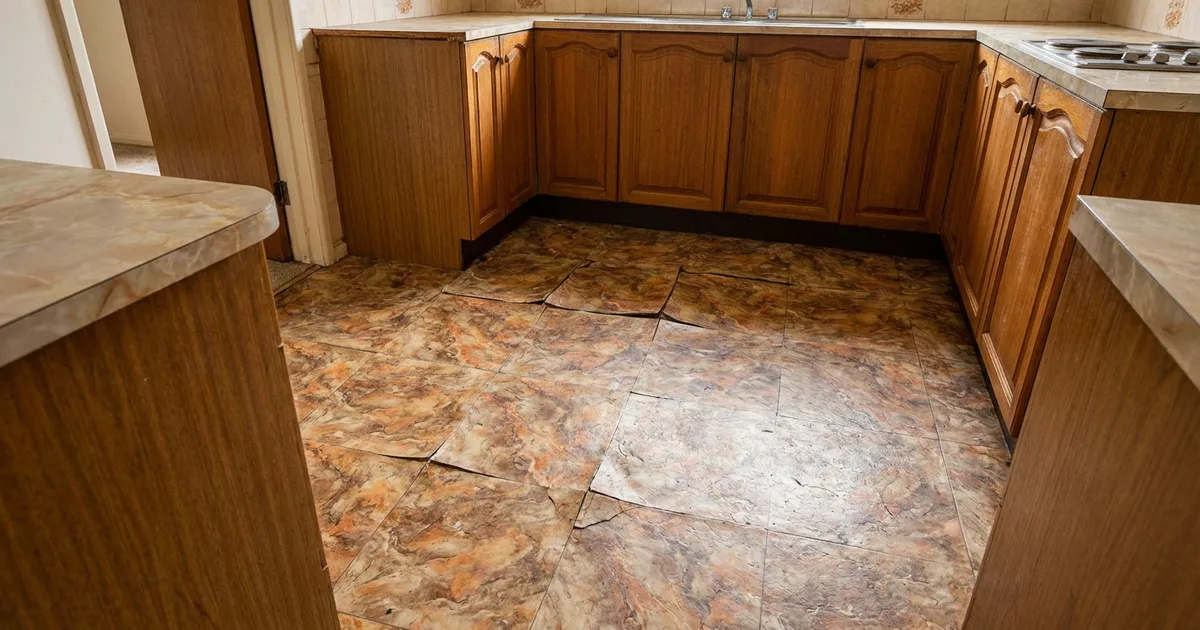
Most people lifting old floor tiles worry about the tile. The adhesive holding it down is the problem nobody tells you about.
The black, tarry mastic used to bond asbestos tiles to subfloors was itself an asbestos-containing product. While the tile sits intact, the risk is minimal. The moment someone scrapes or grinds that adhesive to level the subfloor, they’ve created a genuine fibre exposure event and crossed a legal threshold that requires an HSE-licensed contractor.
Asbestos flooring was a standard UK building product from the early 1950s until 1985. Around 90% of pre-2000 homes surveyed contain asbestos-containing materials of some kind. If your home was built before 1985, there’s a meaningful chance you’re walking on asbestos right now.
That’s not a reason to panic. It’s a reason to understand which part of the floor you disturb, because that single decision determines whether your job needs a licensed contractor.
What Are Asbestos Floor Tiles and Where Are They Found?
Two main product families were used in UK construction: vinyl asbestos tiles (VAT) and thermoplastic asphalt tiles. Chrysotile (white asbestos) was the dominant fibre in both. They were cheap, fire-resistant, hard-wearing, and acoustically insulating. If your nan’s kitchen had those brown marbled squares in the 1970s, these are the tiles.
Blue and brown asbestos were banned in 1985. White asbestos in building products was banned in 1999. That means any tile installed before 1985 is a strong candidate for asbestos content. Tiles installed between 1985 and 1999 may still contain chrysotile. Anything after 1999 is very unlikely unless older materials were reused during a renovation.
You’ll find them most commonly in kitchens, hallways, utility rooms, and bathrooms. Schools, hospitals, and offices from the same period are full of them too. Around 1.5 million UK buildings still contain asbestos in some form, according to HSE and ARCA estimates. If your property is pre-1985, assume the floor tiles are a candidate until proven otherwise.
Floor tiles are just one of several common ACMs in older UK properties. Artex ceilings are another material from the same era that homeowners frequently encounter during renovations.
How to Identify Asbestos Floor Tiles (and Why Looks Alone Aren’t Enough)
Start with the building. A pre-1985 property with original flooring should be treated as suspect. Pre-1970s properties especially so. If someone tells you “it was renovated in the 80s,” that doesn’t clear it. White asbestos in building products was legal until 1999.
Size is the strongest clue. Asbestos tiles were manufactured in imperial dimensions: 9×9 inch (229×229mm) or 12×12 inch (305×305mm) squares. Modern tiles are metric. If you’re pulling up old imperial-sized squares in a 1960s kitchen, that’s a strong signal.
Look at the pattern. Asbestos tiles have a marbled, mottled, or flecked appearance, and the pattern runs through the tile body. It’s not a printed surface layer. That distinction separates them from modern reproductions. Common colours: brown, tan, black, grey, dark green, dark red.
Check the edges. If a loose tile reveals a dark, tarry black adhesive on the subfloor beneath, that’s another visual flag. One that matters more than the tile itself, for reasons explained below.
But here’s the hard limit. A chrysotile tile and a non-asbestos tile can look identical. Visual inspection can’t confirm asbestos. Only laboratory analysis can. And crucially, don’t break or crumble a tile to inspect it. That’s the single most common mistake and it creates the exact fibre release you’re trying to avoid.
The Hidden Risk: Asbestos in the Black Mastic Adhesive
The black bitumen adhesive, known in the trade as “black mastic” or “cutback adhesive,” was used to bond asbestos floor tiles to subfloors throughout the UK. It frequently contains asbestos itself. In some historical formulations, chrysotile concentrations in the mastic reached up to 15–20% by weight. That’s a higher concentration than many of the tiles bonded to it.
While the adhesive remains bonded and covered by the tile, it’s tightly compressed and non-friable. The exposure risk begins the moment that adhesive is scraped, ground, or sanded to prepare the subfloor for a new covering. That process makes the adhesive friable and releases asbestos fibres into the air.
Here’s the scenario that plays out regularly. A homeowner, or an unqualified contractor, lifts the floor tiles carefully. The tiles come up without incident. Then they look at the residual black adhesive on the subfloor and reach for a scraper or a floor grinder to smooth it off. In doing so, they’ve created a serious asbestos exposure event and crossed the legal threshold into work that only an HSE-licensed contractor can perform.
This is the critical distinction that nearly every consumer-facing guide misses. The tile removal didn’t trigger the licensing requirement. The adhesive treatment did. This is also why “my builder said he could do it cheaply” often goes wrong. The tiles come off fine. Then the adhesive removal turns the job into something the builder can’t legally do.
Testing: DIY Kit or UKAS Surveyor?
Visual inspection can’t confirm asbestos. Only laboratory analysis can. Which testing route you need depends on what happens next.
Option A: DIY Test Kit (£30–£60 per sample)
Available from specialist suppliers such as Fibre Check and Asbestos Test UK. You collect the sample yourself following the kit’s safety instructions and post it to a UKAS-accredited laboratory. Results typically come back in 3–5 working days.
The risk: improper sample collection can disturb the tile and create the very exposure you’re trying to assess. This route suits intact, undamaged tiles where you’re confident you can take a clean sample without breaking or crumbling the material.
Option B: UKAS-Accredited Asbestos Surveyor (£150–£400)
A qualified surveyor collects samples under controlled conditions and produces a formal report: ACM locations, condition assessment, analysis results, and a management or removal recommendation. This is required before any licensed asbestos tile removal can legally start. A DIY test kit result doesn’t satisfy that requirement. For a full breakdown of what a survey involves and what drives the price, see our guide on how much an asbestos survey costs.
Always verify surveyor credentials on the UKAS register. UKAS accreditation isn’t the same as general trade body membership. Not all surveyors listed on general directories hold it.
Clear steer: if tiles are intact and undamaged, a DIY kit is reasonable. If tiles are already damaged, crumbling, or you need a formal report for a sale, rental compliance, or licensed removal, get a surveyor.
Leave It, Cover It, or Remove It? A Clear Decision Guide
Not every situation calls for removal. In many cases, removal is the most expensive option and the one most likely to expose you to the adhesive risk described above.
| Factor | Leave / Encapsulate | Remove |
|---|---|---|
| Tile condition | Intact, no damage | Cracked, friable, crumbling |
| Renovation planned? | No disturbance of floor | Floor needs replacing or levelling |
| Property situation | Owner-occupied, stable | Pre-sale, rental compliance, structural works |
| Future use | Light foot traffic | Heavy wear, subfloor work required |
Leave in place. Intact, undisturbed asbestos floor tiles present minimal risk. The fibres are locked in the tile body and aren’t being released. For a stable, owner-occupied property with no renovation plans, this is often the correct choice. It costs nothing.
Encapsulate. Two options here, and they’re often confused. First: an encapsulant sealant coating applied directly to the tiles, costing £8–£33/m² (average around £20/m²). Second: laying a new floor covering (vinyl, wood laminate, carpet) directly over the existing tiles. Either way, no fibre release, no licensing requirements.
Remove. Required when tiles are damaged, when the subfloor needs structural work, or when building regulations demand it (for example, in commercial premises or schools). This is where the adhesive complication enters and where costs escalate.
Many homeowners choose removal because it feels like the “clean” option. It usually isn’t. It’s the most expensive route, the one most likely to disturb the adhesive, and the one that triggers licensing requirements. Unless the tiles are damaged or you need to work on the subfloor, encapsulation is almost always the smarter call.
If you’ve decided removal is the right route, the single most important thing to understand is which legal category your job falls into.
Licensed, Notifiable, or Non-Licensed: Which Law Applies to Your Job?
All asbestos work in the UK falls under the Control of Asbestos Regulations 2012 (CAR 2012). For asbestos tile removal specifically, there are three categories, and each maps to a different scenario.
Non-Licensed Work (CAR 2012, Schedule 3)
Removing intact vinyl asbestos floor tiles in good condition can be non-licensed work if:
- Work intensity is low, with fibre levels not exceeding 0.6 f/cm³ over a 10-minute period
- The tiles aren’t friable or substantially broken
- A risk assessment and appropriate controls are in place
- Workers have received adequate information, instruction, and training
This applies to competent, prepared work, not casual DIY with no controls or precautions.
Notifiable Non-Licensed Work (NNLW)
Applies where tiles are damaged or substantially broken during removal. No HSE licence is required, but you must notify the relevant enforcing authority before work starts. Health surveillance of workers is also required. While no licence is legally mandated, engaging a contractor who holds an asbestos maintenance licence ensures competent handling and proper documentation.
Licensed Work
Mechanical scraping, grinding, or shot-blasting of asbestos-containing adhesive crosses into licensable work in most cases. The process creates high fibre concentrations that exceed the non-licensed thresholds. Only a contractor holding a current HSE standard asbestos removal licence can legally carry out this work. It’s a criminal offence under CAR 2012 to undertake licensable asbestos work without one. Full details on the HSE’s licensing page.
The practical summary:
- Lifting intact tiles → potentially non-licensed (with proper controls)
- Lifting damaged tiles → NNLW (notify the enforcing authority)
- Scraping or grinding the adhesive → licensed work required
The adhesive is where the legal line is. Get this wrong and you or your contractor face prosecution. Always check the HSE’s CONIAC register to verify that any contractor you engage holds an active licence before work starts.
Asbestos Floor Tile Removal Cost: UK Price Guide (2026)
Your quote will depend on tile condition, adhesive state, property size, and location. These are the ranges you should expect in 2026, based on contractor pricing data from Smart Asbestos and Oracle Asbestos. For a broader view across all asbestos types, see our full asbestos removal cost guide.
| Job | Cost Range | Notes |
|---|---|---|
| DIY test kit (per sample) | £30–£60 | Lab analysis included; homeowner collects sample |
| UKAS asbestos survey (domestic) | £150–£400 | Full report with recommendations; required before licensed removal |
| Encapsulation (sealant coat) | £8–£33/m² | Average ~£20/m²; laying new flooring on top is additional |
| Non-licensed tile removal (intact) | £20–£35/m² | Tiles only, no adhesive treatment |
| Licensed removal (tiles + adhesive) | £40–£80/m² | Containment, air testing, disposal included |
| Air clearance testing (post-removal) | £200+ | Required after licensed removal work |
| Hazardous waste disposal | £200–£600 | Minimum load; licensed waste carrier required |
The jump from £20–£35/m² to £40–£80/m² reflects the full cost of licensed containment, air monitoring, and hazardous waste disposal. It’s not contractor profit. It’s the regulatory overhead.
To put that in context: a small kitchen floor of around 15m² could cost £300–£525 for non-licensed tile-only removal, versus £600–£1,200 for licensed removal of both tiles and adhesive. That gap is entirely driven by the adhesive.
Red flag to watch for: a quote significantly below £40/m² for a job that involves adhesive removal should prompt you to ask directly: “Does your quote include the adhesive, and do you hold a current HSE licence?”
How to Find and Verify an HSE-Licensed Contractor
The HSE licence register, maintained by CONIAC, is the authoritative source. Any contractor claiming to handle licensable asbestos work must hold a current licence on that register. It’s a criminal offence to carry out licensable work without one, and responsibility partly falls on the person who commissioned the work if they failed to verify credentials.
Check three things before any work starts. First, confirm the licence is current. Expired licences appear on the register but don’t authorise work.
Second, check the licence type covers removal, not just surveying or maintenance. A maintenance licence doesn’t cover adhesive grinding.
Third, for licensed removal work, the contractor must submit a 14-day notification to the HSE before work starts. If a contractor says they can start tomorrow on a licensed job, that’s a red flag.
Asbestos floor tiles are one of the most manageable ACMs in UK homes. The tile itself isn’t the danger. The adhesive is. Get both tested before anyone touches the floor, and don’t let a contractor near the adhesive without checking their HSE licence first.
Search The Asbestos Register to find and verify licensed contractors in your area.