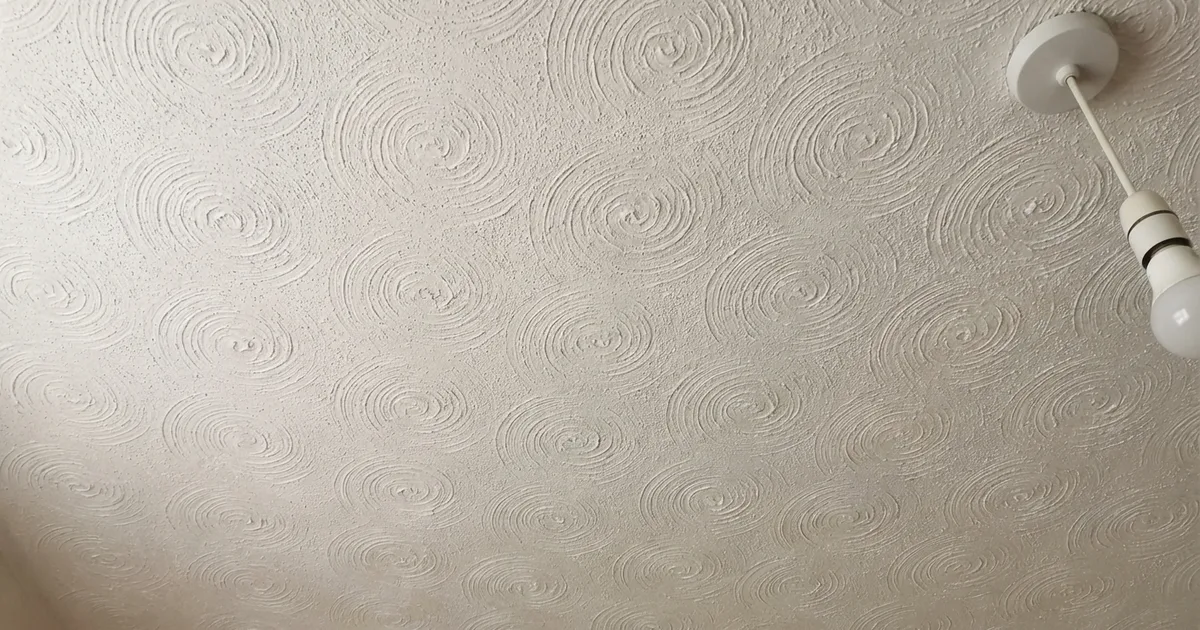
The date most homeowners check is 1984. It’s the wrong date.
Artex stopped manufacturing asbestos-containing products in 1984. But old stockpiles were still being sold and applied in UK homes through to around 2000. If your property was built before 2000, the textured ceiling above you could contain asbestos, regardless of what you’ve read elsewhere about an “80s cutoff.”
If you have asbestos in your Artex ceiling, you need to know three things: how to confirm it, whether it’s actually dangerous in your situation, and what your options are if you need to act. That’s what this covers.
What Is Artex, and Why Does It Matter Now?
Artex is a brand name for textured coatings applied to walls and ceilings. You’ll recognise the patterns: swirls, stipples, comb marks, bark textures. First used in UK homes in the 1930s, Artex became near-universal during the post-war building boom of the 1960s through to the 1980s. If you’ve been inside a pre-2000 UK property, you’ve almost certainly seen it.
The brand is now owned by Saint-Gobain, and modern Artex is completely asbestos-free. The problem is the old product. An estimated 1.5 million UK buildings still contain asbestos-containing materials, and a large share of those are homes with textured ceilings.
If your home has textured ceilings and was built before 2000, the rest of this guide is for you.
Does Artex Always Contain Asbestos?
No. Not all Artex contains asbestos. But older formulations routinely did. Artex manufactured before 1984 contained white asbestos (chrysotile), added to improve strength and drying speed. HSE figures put the asbestos content at roughly 1.8% in ready-mixed products and 3.8% in powder/trade formulations.
Those percentages sound low. They’re not a reason to relax. Disturbing Artex with even 1–4% chrysotile content releases significant fibre counts into the air. Low percentage does not mean low risk.
The timeline is more nuanced than most guides suggest:
| Year | What happened |
|---|---|
| 1960s–1980s | Peak use of asbestos-containing Artex in UK homes |
| 1984 | Artex ceases manufacture of asbestos-containing formulations |
| 1992 | UK bans marketing and supply of asbestos-containing Artex |
| 1999 | Full UK ban on all asbestos-containing materials |
| 1999–2000 | Stockpiles of pre-ban product still being installed in some properties |
That last row is the one that catches people out. Properties built as late as 1998 or 1999 could have been finished using stockpile Artex. If you’re not certain, test.
Which Properties Are at Risk?
Use the table below to assess your own property:
| Property build date | Risk level | Recommended action |
|---|---|---|
| Before 1985 | High | Treat as asbestos-containing until proven otherwise. Do not disturb without professional guidance. |
| 1985–2000 | Possible | Stockpile risk is real. Test before any renovation or ceiling work. |
| After 2000 | Very low to none | No testing required. Modern Artex formulations are asbestos-free. |
The scale is significant. According to industry site survey data, 73% of all sites found to contain asbestos-containing materials were domestic premises. Of those domestic properties assessed, 86% contained some form of ACM. This is not a niche problem. It affects the majority of older UK housing stock.
But this table is a guide, not a diagnosis. Only laboratory testing can confirm or rule out asbestos in your ceiling.
You Can’t Tell Whether Artex Contains Asbestos by Looking at It
This is the most common misconception. Asbestos fibres in Artex are microscopic and chemically bonded into the plaster matrix. They are invisible to the naked eye. No amount of careful looking will tell you whether your ceiling is safe.
Painted, well-maintained Artex looks identical whether it contains asbestos or not. Even crumbling or partially damaged Artex cannot be visually confirmed. A ceiling in perfect condition could contain chrysotile. A ceiling in poor condition might be asbestos-free. You simply cannot tell.
The only reliable identification method is laboratory analysis of a physical sample. A visual inspection tells you nothing about asbestos content. The only way to know is a lab test.
When Does Artex Actually Become Dangerous?
Artex in good condition, left undisturbed, poses minimal risk. The asbestos fibres remain bonded within the plaster matrix and are not being released into the air. The HSE acknowledges that managing asbestos in situ is a valid approach when disturbance risk is low.
Risk increases sharply when the surface is disturbed. The most common accidental exposures happen during:
- Scraping or sanding the ceiling (trying to smooth or remove the texture)
- Drilling into the ceiling (fitting recessed lighting is one of the most frequent triggers)
- Renovation work that disturbs the coating (replastering, removing a wall, building an extension)
- DIY removal without proper precautions
The danger is not the Artex sitting quietly on your ceiling. It’s the Artex you disturb without knowing what’s in it.
The numbers behind this are sobering. Around 5,000 people die every year in the UK from asbestos-related diseases. In 2023, there were 2,218 mesothelioma deaths and an estimated 2,500 deaths from asbestos-related lung cancer. Mesothelioma has a latency period of 20 to 50 years, meaning today’s exposures won’t show symptoms for decades.
Current deaths largely reflect occupational exposure from the 1960s through 1980s. The emerging concern is domestic DIY exposure. Drilling into untested Artex, fitting recessed lighting without checking the ceiling first: these are the scenarios driving the next wave of cases.
Leave It, Seal It, or Remove It: Choosing the Right Option
You have three options. Which one applies depends on the condition of your Artex, whether you’re planning renovation, and your budget.
Option 1: Leave it in place (manage)
Appropriate when the Artex is in good condition, no renovation is planned, and there’s no visible deterioration. The HSE supports managing asbestos in situ as a valid approach under these conditions.
This is not a “do nothing” option. It requires regular monitoring for deterioration, documentation of where the Artex is and what condition it’s in, and disclosure to any future buyer or contractor working in the property. You’re actively choosing to manage it, not ignoring it.
Option 2: Encapsulate (seal it)
Artex can be sealed with specialist encapsulant paint or covered with new plasterboard. This is typically cheaper than removal, costing around £200 to £500 depending on the area size. It does not eliminate the asbestos, it seals it in place.
Encapsulation is appropriate when removal would cause more disturbance than leaving the material in situ, or when budget is a constraint. The caveat: future renovation work still requires precautions, and the asbestos must still be disclosed when selling the property.
Option 3: Remove (licensed contractor only)
Required when the Artex is damaged or deteriorating, when renovation is planned that will disturb the ceiling, or when complete removal is the only option that fits the circumstances.
All asbestos removal work is governed by the Control of Asbestos Regulations 2012. Artex removal may be classified as non-licensed or licensed work depending on the material type, condition, and duration of the job. A surveyor’s assessment determines which classification applies. Don’t assume. It is a criminal offence to carry out licensable asbestos work without an HSE standard licence.
If you’re planning any ceiling work in a pre-2000 home, whether that’s recessed lighting, replastering, or an extension, removal is the right choice. The cost of a test is £65 to £150. The cost of getting it wrong is a disease with a latency period measured in decades.
How Artex Asbestos Testing Works, and What It Costs
An artex asbestos test is straightforward. A UKAS-accredited asbestos surveyor visits your property, carefully extracts a small sample (roughly 1cm²) from the Artex surface, and sends it to a UKAS-accredited laboratory. The sample is analysed under polarised light microscopy. You get a written report within 24 to 48 hours confirming whether asbestos is present and, if so, the percentage content.
Costs vary depending on the scope:
| Testing option | Cost |
|---|---|
| DIY postal test kit (homeowner collects sample) | £25–£50 |
| Professional surveyor + lab analysis, single room | £65–£150 |
| Full asbestos survey, 1–2 bed flat | ~£250 |
| Full asbestos survey, 3–5 bed house | ~£350 |
The DIY postal kit is not recommended for Artex specifically. Sampling textured coatings without training creates the very exposure risk you’re trying to assess. A professional surveyor knows how to extract a sample without releasing fibres.
One important technical point: Artex is what the trade calls a “non-homogenous” material. The asbestos is not evenly distributed throughout the coating. A single sample may not be representative of the whole ceiling. Reputable surveyors take multiple samples from different areas and layers. Ask any surveyor about their sampling approach before you commit. Insist on UKAS-accredited lab results. A test from a non-accredited lab is not reliable.
Asbestos Artex Removal Costs
If the test confirms asbestos and removal is the right choice, here are the costs you should expect. These are 2025–2026 guide prices from trade platforms including Checkatrade, MyJobQuote, and PriceYourJob.
| Scope | Estimated cost |
|---|---|
| Single room removal (30m²) | £300–£700 |
| Average residential project | £500–£2,000 |
| Cost per m² (licensed removal) | £40–£65+ |
| Larger/specialist licensed work (20m²) | £2,750–£6,000 |
| Encapsulation (alternative) | £200–£500 |
Several factors affect where your quote falls within these ranges: the size of the area, whether the work is classified as licensed or non-licensed, ceiling height and accessibility, disposal fees (asbestos is classified as hazardous waste requiring specialist disposal), geographic location (London and the South East are typically higher), and the condition of the Artex itself. Crumbling material requires more controlled removal and costs more.
After any asbestos removal, ask your contractor for a written disposal certificate. This protects you legally and is required for disclosure on any future property sale. Get three quotes from licensed contractors. Compare scope of work, not just price. The cheapest quote often means corners cut on containment or air monitoring.
How to Find and Verify a Licensed Asbestos Contractor
Not all contractors are authorised to remove asbestos. Only companies holding a current HSE licence may carry out licensable asbestos removal work. Using an unlicensed contractor is not just a health risk. If something goes wrong, the homeowner may carry legal liability under the Health and Safety at Work Act 1974 for exposing workers to asbestos without warning.
Four checks to make before hiring any contractor:
- Ask for their HSE licence number.
- Check the CONIAC register to confirm the licence is current and covers your type of work.
- Check whether they hold ARCA membership. Not all licensed contractors are ARCA members, but it’s an additional quality signal.
- Ask for a written scope of work and a disposal certificate on completion.
The CONIAC register is public, but it’s not consumer-friendly. It’s an Excel download, not a searchable directory. Asbestos Register UK lists all 355 HSE-licensed asbestos removal contractors in one searchable directory, verified against the CONIAC register. You can find licensed contractors in Kent, compare licensed asbestos removal contractors in Essex, or search by any county in the UK.
Buying or Selling a Property with Artex?
For buyers
If Artex has been flagged in a homebuyer survey, get a specialist asbestos survey (Type 2/Management Survey) done before exchange on any pre-2000 property. The presence of asbestos Artex does not make a property unmortgageable or unsaleable. It depends on condition and lender requirements.
Confirmed ACM presence is a legitimate negotiating point. Deduct estimated removal costs from your offer. Some mortgage lenders require a management report or removal certificate before completing on properties with known asbestos. Check with your lender before making an offer, not after. If the lender needs a report, factor that into your timeline and budget from the start.
For sellers
Known asbestos must typically be disclosed to buyers. If you’ve had an asbestos survey done, provide the report as part of your legal pack.
Consider getting a test done before marketing the property. A clean result removes a common buyer objection and can speed up conveyancing significantly. Even a positive result puts you in control of the narrative: you can get removal quotes, factor the cost into your asking price, and present buyers with a clear picture rather than an unknown risk.
Artex asbestos in a property is a manageable issue, not a dealbreaker. The buyers who walk away are the ones who don’t have clear information. Give them the facts and the problem shrinks.
What to Do Next
Undisturbed Artex in good condition is manageable. The risk comes from acting without knowing what’s in your ceiling. If your home was built before 2000 and you have textured coatings, the next step is a test. It costs £65 to £150 for a professional surveyor, results come back within 48 hours, and you’ll know exactly where you stand.
If the test comes back negative, you can renovate without restriction. If it’s positive, you have a clear path: manage it in place, encapsulate it, or remove it with a licensed contractor.
If removal is the right choice, use a contractor who holds a current HSE licence. Verify them on the CONIAC register, or search our directory of all 355 licensed contractors to find verified options in your area.
Frequently Asked Questions
Does all Artex contain asbestos?
No. Not all Artex contains asbestos, but older formulations routinely did. Artex made before 1984 contained white asbestos (chrysotile) at roughly 1.8% in ready-mixed products and 3.8% in powder/trade formulations. Artex applied after 2000 is asbestos-free. The grey area is 1985 to 2000, when pre-ban stockpiles were still being installed, so any textured ceiling in a property built before 2000 should be tested before it is disturbed.
How can you tell if Artex contains asbestos?
You can’t tell by looking. Asbestos fibres in Artex are microscopic and bonded into the plaster matrix, so painted, damaged or perfect-condition Artex all look identical whether or not they contain asbestos. The only reliable method is laboratory analysis of a physical sample taken by a UKAS-accredited surveyor and tested under polarised light microscopy.
When did they stop putting asbestos in Artex?
Artex stopped manufacturing asbestos-containing formulations in 1984. The UK banned the marketing and supply of asbestos-containing Artex in 1992, and all asbestos-containing materials were banned in 1999. Because pre-ban stockpiles were still being applied, some properties built as late as 1998 to 2000 can still have asbestos Artex.
What percentage of asbestos is in Artex?
HSE figures put the asbestos content of older Artex at roughly 1.8% white asbestos (chrysotile) in ready-mixed products and 3.8% in powder/trade formulations. These percentages sound low but are not a reason to relax: disturbing Artex with even 1 to 4% chrysotile content releases significant fibre counts into the air.
How much does it cost to remove asbestos Artex?
Single-room Artex removal typically costs £300–£700, with a cost per m² of around £40–£65 for licensed removal. An average residential project runs £500–£2,000, while larger or specialist licensed work can reach £2,750–£6,000. Encapsulation (sealing it in place) is a cheaper alternative at £200–£500.
How much does an Artex asbestos test cost?
A professional surveyor plus UKAS-accredited lab analysis for a single room costs around £65–£150, with written results in 24 to 48 hours. A DIY postal test kit is £25–£50 but is not recommended for Artex, because sampling textured coatings without training creates the very exposure risk you’re trying to assess.
Do you need a licence to remove asbestos Artex?
It depends. Artex removal may be classified as licensed or non-licensed work under the Control of Asbestos Regulations 2012, depending on the material type, condition and duration of the job. A surveyor’s assessment determines which applies. Where the work is licensable, only a contractor holding a current HSE licence may carry it out, and it’s a criminal offence to do licensable asbestos work without one.
Is Artex with asbestos dangerous if left alone?
Artex in good condition and left undisturbed poses minimal risk, because the fibres stay bonded in the plaster matrix. The HSE accepts managing asbestos in situ when disturbance risk is low. Risk rises sharply when the surface is disturbed by drilling, sanding, renovation or DIY removal, which is why testing before any ceiling work in a pre-2000 home is essential.