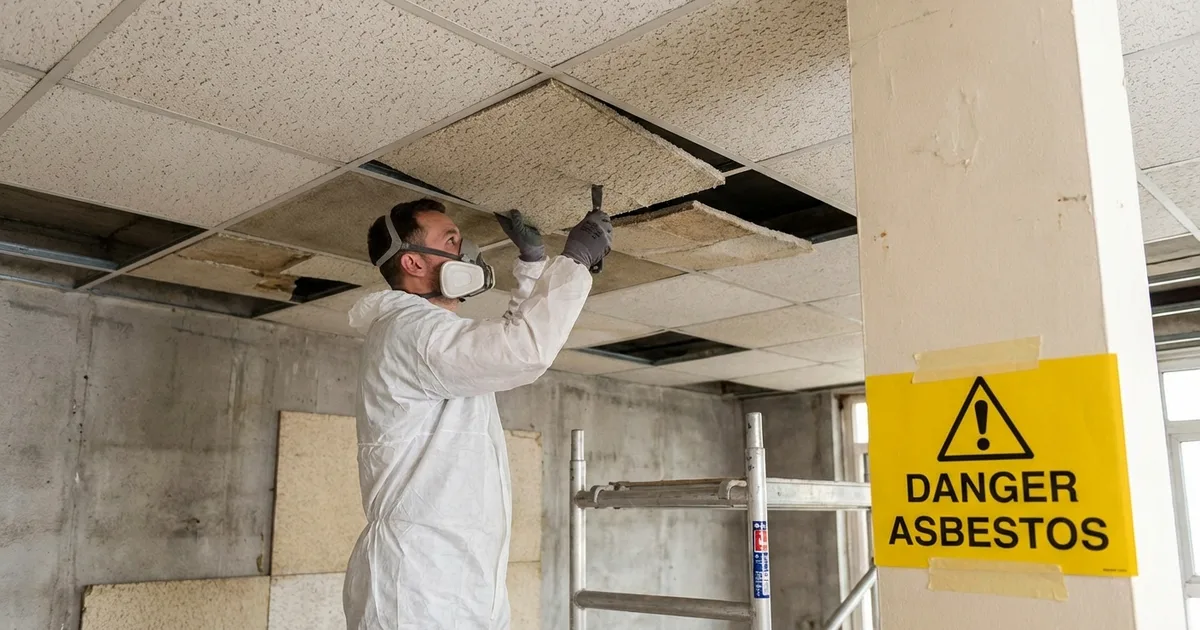
The ceiling tiles above your head may contain three times more asbestos than the garage roof your neighbour had removed last year. UK law makes it a criminal offence for anyone without an HSE licence to touch them.
That’s the reality of asbestos insulating board, known in the trade as AIB. It isn’t just another asbestos type. It contains a higher density of far more dangerous fibres than standard asbestos cement, and the Control of Asbestos Regulations 2012 classify almost all work involving it as licensable. The penalties for getting this wrong are criminal, not civil.
We’re a directory, not a contractor. We list every HSE-licensed removal company in the UK, but we have zero interest in steering you toward removal if you don’t need it. What follows is the data on why AIB is more dangerous than other asbestos types UK buildings contain, what the law actually requires, and how to make the right call for your property.
Why AIB Is More Dangerous Than Other Asbestos Types
Every asbestos page on the internet calls AIB “the most dangerous.” Almost none of them prove it. Here’s the data.
AIB asbestos contains 20–45% asbestos by weight. Standard asbestos cement, the material used in garage roofs, soffits, and water tanks, contains 10–15%. That’s a direct, measurable difference. Per square metre of material disturbed, AIB releases significantly more fibres into the air.
The fibre type matters as much as the quantity. Asbestos cement predominantly contains chrysotile (white asbestos). AIB uses amosite (brown asbestos) and sometimes crocidolite (blue asbestos). Both are IARC-classified as more carcinogenic than chrysotile. Amosite and crocidolite fibres are longer, thinner, and stay in lung tissue longer once inhaled. That’s why they are more strongly associated with mesothelioma.
AIB is also more friable than asbestos cement. It crumbles rather than breaking cleanly. The same property that made it easy to cut and fit on 1960s construction sites now makes any accidental damage far more hazardous. A knock, a drill hole, even a heavy impact can release invisible fibres into the room.
The consequences of exposure play out over decades. In 2023, 2,218 people in Great Britain died from mesothelioma, according to the HSE’s Asbestos-Related Disease Statistics. When you include asbestos-related lung cancer and asbestosis, the total reaches approximately 5,000 deaths per year, according to UKATA. The latency period is 20–50 years. Workers exposed to AIB in the 1970s are dying from it now. That’s why the death toll remains above 2,200 annually despite asbestos being banned in 1999.
Where AIB Was Used in UK Homes and Buildings
If your property was built or substantially renovated between 1950 and 1985, assume AIB is present until a survey proves otherwise. Post-1985 properties carry lower risk but aren’t immune. AIB installed during the original build may still be hidden behind later renovations.
AIB was manufactured from the 1950s until around 1980, when production ceased. The material wasn’t banned outright until 1999. During that 40-year window it was fitted across virtually every building type: homes, schools, hospitals, offices, and factories. An estimated 1.5 million UK buildings still contain asbestos in some form.
These are the specific locations where AIB was commonly installed:
- Ceiling tiles, particularly in 1960s–70s homes and commercial properties converted to flats
- Internal wall panels and partition boards, especially around heating systems, in corridors, and stairwells
- Fire doors, where AIB panels were fitted inside the door leaf for fire separation
- Soffits, both external (eave overhangs) and internal soffits around structural steelwork
- Lift shaft linings, used extensively in blocks of flats and commercial buildings
- Window spandrel panels, the infill panels between floors in curtain-walled buildings
- Boxing around pipes and structural steelwork, very common on 1960s–70s housing estates
- Boiler rooms and airing cupboards, as lagging boards around heating equipment
How to Identify Asbestos Insulating Board, and Why You Probably Can’t
AIB looks almost identical to modern plasterboard, MDF, and calcium silicate board. That isn’t a coincidence. It was designed as a lightweight, easy-to-install board material. The HSE guidance is explicit: do not try to determine if a material is AIB by touch or visual inspection. Treat all suspect material as if it contains asbestos until tested.
You’ll still want to know what to look for before you call a surveyor. If you own an older property, you’ll look regardless. These signs warrant testing:
- Building age: property built or refitted between 1950 and 1985
- Board appearance: pale grey, off-white, or cream finish, thinner than modern plasterboard (often 6mm, 9mm, or 12mm)
- Location: fire doors, ceiling tiles, soffits, or boxed-in pipe runs in older buildings
- Chalky residue on damage: where boards have been broken, a white or grey chalky debris rather than the fibrous paper-faced debris you’d see from modern plasterboard
None of these confirm AIB. The only certain method is bulk sampling by a trained analyst, sent to a UKAS-accredited laboratory for analysis. This costs £30–£100 per sample. Air sampling using phase contrast microscopy is used after removal to verify the air is clear.
A management survey for a residential property typically costs £150–£400. It’s worth commissioning before any renovation work on a pre-1985 property. For non-domestic buildings, the survey is a legal requirement under Regulation 4 of CAR 2012 (the duty to manage).
For a detailed breakdown of what surveys involve and how pricing works, see our guide on how much an asbestos survey costs.
The Law: When Is AIB Removal Legally Required?
The governing regulation is the Control of Asbestos Regulations 2012, or CAR 2012 (SI 2012/632). It creates three tiers of work based on risk, and understanding which tier applies to your situation determines everything that follows.
Licensed work
Almost all asbestos insulation board removal or substantial disturbance falls into this category. It requires a contractor holding a current HSE standard asbestos licence, renewed every three years by the HSE. Before work can begin, the contractor must submit a 14-day advance notification to the HSE using form ASB5. Even in an urgent situation, licensed work cannot legally start for two weeks after the notification is filed.
The work itself demands a full enclosure with negative pressure ventilation, continuous air monitoring throughout the job, and an independent four-stage clearance air test before anyone can re-occupy the space. Full details are available on the HSE’s licensing page.
Non-licensed but notifiable (NNLW)
This applies only to very limited, very short-duration AIB tasks. An example would be removing a single undamaged ceiling tile where a risk assessment confirms minimal fibre exposure. No HSE licence is required, but the work must still be notified to the HSE, and the employer must keep medical records of workers involved.
Non-licensed work
Encapsulating (painting or sealing) undamaged AIB, or drilling a single hole under strict controls, does not require a licence. It does require a written risk assessment and appropriate controls. This category covers only work where the risk assessment confirms very short duration and low exposure.
Criminal liability
Carrying out licensable work without an HSE licence is a criminal offence. Both the contractor and the client can face prosecution. Checking a contractor’s licence isn’t optional. It’s a legal requirement, and failing to do it can make you personally liable.
Separately, Regulation 4 of CAR 2012 imposes a “duty to manage” on building owners and landlords. You must survey, record, and actively manage any asbestos-containing materials (ACMs) in non-domestic premises, including AIB. Failing to manage asbestos is itself a prosecutable offence.
Leave It, Seal It, or Remove It: A Decision Framework
Most content on this topic says “call a professional” without helping you understand what question you’re actually asking. There are three options, and the right one depends on your specific situation.
Option 1: Leave and monitor
This is appropriate when AIB is in good condition, in an area unlikely to be disturbed, and protected from accidental damage. You need an annual inspection and a written asbestos management plan. For undamaged, sealed AIB in a location nobody will touch, this is often the safest and most cost-effective choice.
Option 2: Encapsulate
Encapsulation means applying an approved sealant or paint that locks in the fibres. It’s appropriate when AIB is lightly damaged or sits in a location where future disturbance is possible. This is non-licensed work, but it requires a professional risk assessment and ongoing monitoring afterwards. The critical thing to understand: encapsulation defers the problem, it doesn’t solve it.
Any future renovation or demolition will still require licensed removal of the underlying material.
Option 3: Remove
Removal is required when AIB is heavily damaged, when any renovation or demolition work will disturb it, or when ongoing management is impractical. Selling a property or converting its use are common triggers. Removal always requires an HSE-licensed contractor, and the 14-day HSE notification means this cannot be rushed. If you’re planning a property sale or refurbishment, build that two-week lead time into your schedule from the start.
The decision rule
If you’re unsure which option applies, get a survey first. A management survey tells you the condition of the material, its location, and which response is appropriate. Don’t decide without professional assessment. The survey cost (£150–£400) is a fraction of the cost of getting the decision wrong.
What Does Asbestos Insulation Board Removal Cost in the UK?
Licensed AIB removal runs £100–£300 per m². That’s two to three times the cost of removing asbestos cement (the material in garage roofs and soffits), because AIB work requires a full enclosure, continuous air monitoring, and a four-stage clearance test before anyone can re-enter the space.
| Item | Typical Cost |
|---|---|
| Licensed AIB removal | £100–£300 per m² |
| Non-licensed asbestos cement removal (comparison) | £50–£150 per m² |
| Asbestos management survey (residential) | £150–£400 |
| Bulk sample + lab analysis | £30–£100 per sample |
| Air clearance certificate (post-removal) | Included in licensed price; standalone ~£200–£400 |
Costs vary by region, volume of material, and access conditions. A small residential job, say 5m² of AIB ceiling tiles, might cost £500–£1,500 all in. A full fire-door replacement programme across a block of flats could run £10,000–£50,000 or more.
Remember the 14-day HSE notification requirement. It means work cannot start for two weeks after a price is agreed and the notification is filed. If you’re selling a property or planning a renovation, that lead time needs to be in your project plan from day one. For a full breakdown of asbestos removal costs in the UK, including asbestos insulation board removal cost UK benchmarks, see our dedicated cost guide.
Finding and Verifying a Licensed Contractor
The HSE’s public licence register is the authoritative source. Any contractor claiming to carry out licensable asbestos work must hold a current licence on that register. Expired licences appear but don’t authorise work. Licences are renewed every three years.
Check three things before any work starts. First, confirm the licence is current and hasn’t expired. Second, check that the licence type covers removal, not just surveying or maintenance. A maintenance licence doesn’t cover AIB removal. Third, for licensed work, the contractor must submit the 14-day HSE notification before starting. If a contractor tells you they can begin tomorrow on a licensed job, that’s a red flag.
AIB is manageable. It requires the right assessment, the right legal framework, and the right people. You can search the HSE register yourself, or use our directory, where we’ve already verified every listing against it.
Find an HSE-licensed asbestos removal contractor near you using our directory. Every listing is verified against the HSE register. You can also browse licensed asbestos removal contractors in your county to compare ratings, reviews, and contact details.