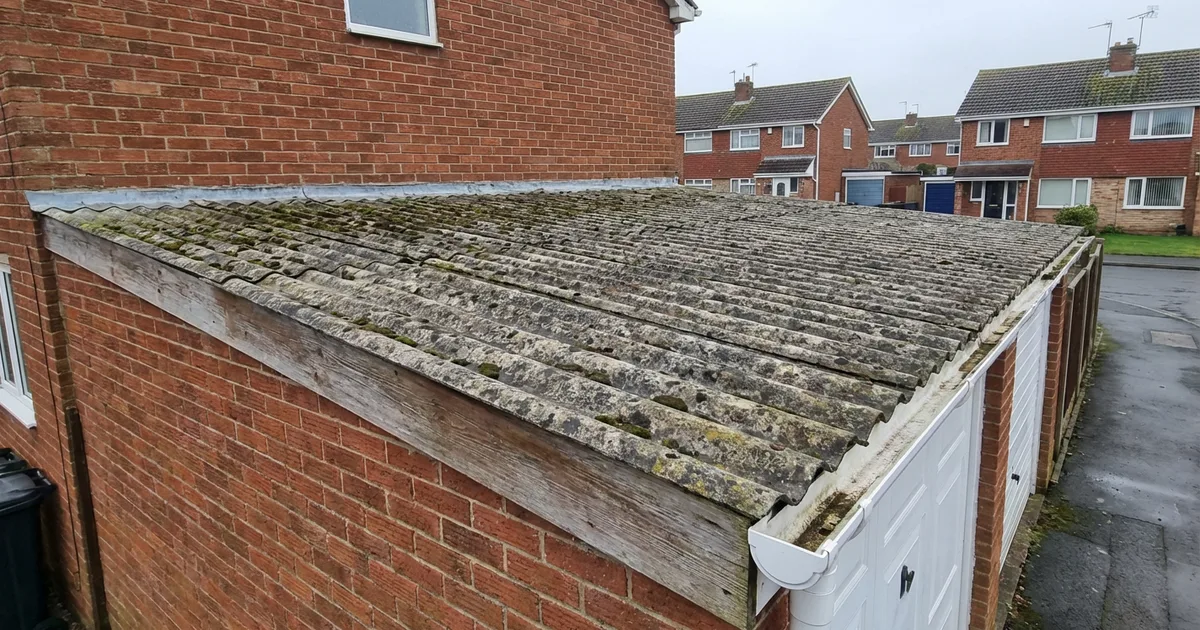
Most online guides about asbestos garage roofs get the regulations backwards. The removal, if it’s done carefully with intact sheets, doesn’t actually require an HSE-licensed contractor under UK law. What always requires a licensed waste carrier is getting rid of it afterwards. That’s the detail that catches homeowners out.
The removal is governed by the Control of Asbestos Regulations 2012 (CAR 2012). The disposal is governed by the Hazardous Waste Regulations 2005. Two separate pieces of law, two separate credentials, and most contractors you’ll find on general trades sites hold one credential at best.
This guide covers the actual cost of asbestos garage roof removal in 2026 (from £600 for a single garage), the three-tier licensing framework that determines who can legally do the work, what replacement materials to choose, and the two specific credential checks to run before you hire anyone. If you’ve been putting this off because the rules seemed confusing, this is the straight answer.
Is Your Garage Roof Actually Asbestos?
Corrugated or flat fibre cement sheets on garages built before 2000 are almost certainly asbestos cement. The material is chrysotile (white asbestos) bonded into a Portland cement matrix, typically 10–15% asbestos by weight. That’s enough to be hazardous if fibres are released, but significantly less than the friable materials found in insulation boards. When intact and unweathered, bonded asbestos cement releases very few fibres. Approximately 1.5 million UK buildings still contain asbestos in some form, according to HSE and industry estimates, and garage roofs are the single most common residential asbestos job.
Visual cues: grey or weathered corrugated sheeting, small bolt heads through the sheets into timber purlins, and any roof that pre-dates the 1999 ban on chrysotile. The sheets are rigid, heavy, and often covered in moss or lichen after decades of exposure.
One critical distinction. If your garage has an internal lining, such as ceiling boards or partition walls, those may contain Asbestos Insulating Board (AIB). AIB is a friable material with much higher fibre release potential than bonded asbestos cement. Any AIB present means a fully HSE-licensed contractor is required regardless of the roof condition. AC sheets on the roof surface and AIB internally are two very different risk categories.
If you’re not sure what you’re looking at, a laboratory sample test costs £75–£150 per sample. A visual management survey from a qualified surveyor runs approximately £150–£325. Either route confirms the material type before you commit to any work.
Remove It or Encapsulate It? A Simple Decision Framework
If the sheets are intact, not cracked, and not visibly weathered or powdering, encapsulation is a legitimate option. A specialist sealant is applied to lock in the fibres and extend the roof’s usable life by 10–15 years. Cost: approximately £15–£30/m², which is significantly cheaper than removal.
But encapsulation is a delay, not a fix. The roof will still need removing eventually, and you’ll need annual condition checks to monitor for deterioration. It buys time. It doesn’t resolve the problem.
Remove when: sheets are cracked, corroding, weathered to the point where the surface feels soft or chalky, or when the roof is being replaced anyway as part of a wider project. If you’re converting the garage, extending the property, or the roof leaks, encapsulation doesn’t make sense.
If the roof has more than a decade of visible life left and sheets are intact, get an encapsulation quote before committing to full removal. If the sheets are visibly degrading, cracking, or chalky to the touch, remove it now. Don’t wait for a storm to make the decision for you.
Asbestos Garage Roof Removal Cost in the UK (2026 Prices)
A single domestic garage with a standard corrugated asbestos cement roof costs £600 to £1,500 for removal only, with an average around £945. A double garage runs £1,200 to £2,500+. These are 2026 figures from UK contractor pricing data. Here’s the full breakdown — and if you’re weighing this against other jobs in the house, our asbestos removal cost guide compares every material type.
| Garage Size | Approx. Area | Removal Cost |
|---|---|---|
| Single garage | 15–18 m² | £600–£1,500 (avg £945) |
| Double garage | 28–32 m² | £1,200–£2,500+ |
| Per m² rate | ~£50/m² |
These figures cover removal, safe packaging, and disposal of the asbestos sheets. They do not include a new roof.
What drives the variation? Condition of the fixings is the biggest factor. Corroded bolt heads that have fused to the sheets make intact removal harder and slower. Access matters too: if the garage is hemmed in by fences or other structures, scaffold setup takes longer. Regional location plays a role. London and the South East typically run 20–40% above the national average. A single garage that costs £945 nationally might cost £1,100–£1,300 in the South East.
If you need a survey first because you’re unsure whether the material is asbestos cement or something more hazardous like AIB, a visual management survey costs approximately £150–£325. A laboratory sample test is £75–£150.
Full Replacement Costs (Removal + New Roof)
Most homeowners don’t just remove the old roof. They replace it at the same time. Here are the all-in figures for asbestos garage roof replacement cost.
| Garage Size | Total Cost (Removal + New Roof) |
|---|---|
| Single garage | £1,150–£4,500 |
| Double garage | £2,000–£5,000+ |
The wide range reflects material choice. A basic bitumen felt replacement on a single garage sits at the lower end. A GRP fibreglass roof with new timber framework pushes towards the upper end.
The Rules: What the Law Actually Says About Asbestos Garage Roof Removal
The Control of Asbestos Regulations 2012 (CAR 2012) creates three tiers of asbestos work. Getting this right matters, because the tier determines who can legally do the job and what paperwork is required.
Non-licensed work. Removing asbestos cement roof sheets intact, without breaking them, is classified as non-licensed work under CAR 2012. The HSE’s own guidance confirms this explicitly. No HSE licence is required. The worker needs adequate training, a risk assessment, appropriate PPE, and wet methods to suppress dust. The legal control limit is 0.1 fibres per cm³ of air. Intact asbestos cement removal stays well below that threshold when proper wet methods are used.
Notifiable Non-Licensed Work (NNLW). If sheets must be broken during removal, for example because of storm damage or corroded fixings that can’t be unscrewed, the job becomes NNLW. The HSE must be notified before work starts. Health surveillance of workers is required. Still no HSE licence, but the paperwork and controls step up significantly.
Licensed work. Any AIB present triggers the requirement for a fully HSE-licensed contractor. A contractor holding an HSE standard licence has met the training, equipment, and supervision requirements set by the Health & Safety Executive.
Here is the detail that almost every other guide misses. Regardless of whether the removal itself is non-licensed or licensed, disposal of asbestos waste always requires a carrier registered with the Environment Agency (or SEPA in Scotland, NRW in Wales). This obligation comes from the Hazardous Waste Regulations 2005, not CAR 2012. It’s a separate legal requirement entirely.
Many unlicensed builders and general roofers do not hold Environment Agency waste carrier registration. That makes their disposal technically illegal even when the removal itself was perfectly lawful. The homeowner carries legal exposure too, because you have a duty of care over your own waste.
An HSE-licensed contractor holds both credentials by definition and provides a consignment note as proof of legal disposal. Keep that consignment note for a minimum of two years. For most homeowners, hiring a licensed contractor is the path of least risk, even when the regulations don’t technically require it. You can verify any contractor’s HSE licence on the CONIAC register and their waste carrier registration on the EA public register.
Can You Remove It Yourself?
Legally, a homeowner can remove asbestos cement sheets themselves under the non-licensed work rules. The requirements: wet the sheets before and during removal, remove them intact without breaking, wear FFP3 respiratory protection and disposable coveralls, and double-bag and label all waste with asbestos hazard warnings.
Three practical barriers make most DIY attempts problematic.
Working at height. A garage roof means working 2–3 metres up. You need scaffold or a proper working platform, not a step ladder. Falls from height are the most common cause of death in UK construction.
Corroded fixings. Bolt heads on old asbestos cement roofs corrode into the sheet surface over decades. Removing them without cracking the sheet is genuinely skilled work. One broken sheet escalates the entire job from non-licensed to NNLW, requiring HSE notification.
Disposal. Some Household Waste Recycling Centres accept small quantities of double-bagged asbestos cement waste from householders. Many have quantity limits and some don’t accept it at all. Always phone your local HWRC before starting work. If they won’t take it, you’ll need to hire an EA-registered waste carrier anyway.
If you’re confident working at height, the fixings aren’t corroded, and your local HWRC confirms they’ll take the waste, a small single-garage job is manageable as a DIY project. Anything larger, anything degraded, or any uncertainty about disposal, get quotes from a licensed contractor. The cost difference between professional removal and a DIY attempt that goes wrong is not worth the risk.
What Happens on Removal Day
Most single and double domestic garage roof removals complete in half a day to one full day. Here’s what the process looks like.
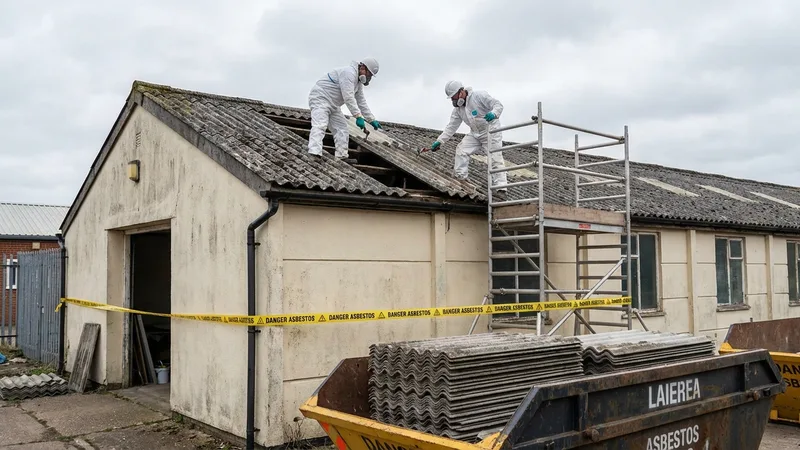
The contractor inspects the roof, confirms the material type (AC vs AIB), and produces a written method statement. The work area is cordoned off to keep others clear. Sheets are dampened with water to suppress any fibre release.
Removal works from the ridge downwards. Each sheet is unscrewed from the purlins and lowered, not dropped. This is where the quality of the contractor shows. Corroded bolt heads are the single biggest complication. A rushed contractor drills or breaks through them, and that’s the moment a legal non-licensed job becomes NNLW with HSE notification requirements. A good contractor takes the time to cut the fixings cleanly.
Each sheet is double-bagged or wrapped immediately after removal and labelled with asbestos hazard warnings. The site is cleaned and inspected. For NNLW jobs, post-removal air monitoring is conducted to confirm fibre levels are safe before the area is cleared for re-entry. The bagged waste is transported to a licensed hazardous waste site, and the contractor provides a consignment note confirming legal disposal.
Weather matters. Wet, calm conditions are ideal because moisture naturally suppresses dust. High winds are a problem for handling large sheets safely. Most contractors will reschedule rather than work in gusty conditions.
The new roof can start the same day or the following day, depending on the contractor’s schedule and whether they handle both removal and roofing.
What to Replace It With: Materials and Costs
Once the asbestos sheets are off, you need something to go back on. Six main options, each with different cost, lifespan, and suitability for a typical garage roof profile.
| Material | Installed Cost | Lifespan | Notes |
|---|---|---|---|
| Corrugated fibre cement | £30–£50/m² | 30+ years | Like-for-like replacement, no asbestos |
| Bitumen felt (torch-on) | £25–£40/m² | 10–15 years | Budget option, shorter lifespan |
| EPDM rubber | £40–£60/m² | 20–25 years | Durable, suits flat or low-pitch roofs |
| GRP fibreglass | £50–£80/m² | 30+ years | Premium, seamless finish |
| Metal/steel panels | £45–£70/m² | 25+ years | Good longevity, modern appearance |
| UPVC/PVC | £40–£65/m² | 20+ years | Lightweight, low maintenance |
For most garages, corrugated fibre cement is the straightforward like-for-like replacement. Same profile as the original, good durability, no asbestos. Fibre cement and metal panels suit the corrugated profiles most garages have. If you’re converting to a flat or low-pitch roof, EPDM rubber is the best value upgrade with a 20–25 year lifespan and minimal maintenance. For the premium long-term choice, GRP fibreglass gives a seamless, watertight finish that outlasts most other options. Bitumen felt works on both profiles but won’t last as long.
How to Find and Verify a Contractor: Two Checks That Matter
Two credentials to verify before any money changes hands.
1. HSE licence. The CONIAC register is the definitive list of all HSE-licensed asbestos removal contractors in the UK. If a contractor claims to hold an HSE licence, their company name and licence number will appear on this register. An expired licence doesn’t authorise work.
2. EA waste carrier registration. Required for all asbestos waste disposal, regardless of whether the removal itself is licensed or non-licensed. Verify the contractor’s registration on the Environment Agency’s public register before engaging them.
Why both matter: a contractor can legally remove non-licensed asbestos cement roofing without an HSE licence. But they still cannot legally dispose of the waste without EA registration. Asking for both credentials screens out the contractors who cut corners on disposal. That’s where the legal exposure sits for the homeowner as much as the contractor.
Ask for the consignment note in writing before work starts. This is your proof of legal disposal. Keep it for at least two years.
Asbestos Register UK lists all HSE-licensed contractors in the UK, verified against the official CONIAC register and searchable by county. You can browse verified contractors in your area, compare ratings and reviews, and request quotes directly from their listing pages.
Frequently Asked Questions
How much does it cost to remove an asbestos garage roof in the UK?
Removal costs for a single domestic garage typically range from £600 to £1,500, with an average around £945. A double garage runs £1,200–£2,500+. These are removal-only costs. If you’re replacing the roof at the same time, budget £1,150–£4,500 for a single garage all-in. Prices run 20–40% higher in London and the South East.
Do I need a licensed contractor to remove an asbestos garage roof?
Not necessarily. Under Control of Asbestos Regulations 2012, removing asbestos cement (the corrugated sheets found on most pre-2000 garages) is classified as non-licensed work if sheets are removed intact without being broken. However, disposal always requires a carrier registered with the Environment Agency. Many unlicensed builders don’t hold this registration. An HSE-licensed contractor holds both credentials and provides a legal disposal trail.
Can I remove an asbestos garage roof myself?
Legally, yes, provided you wet the sheets first, remove them intact, wear FFP3 respiratory protection and disposable coveralls, and dispose of the bagged waste at a licensed facility. In practice, the barriers are working safely at height (scaffold required), corroded fixings that make intact removal difficult, and finding an HWRC that accepts asbestos waste. Many have quantity limits. One broken sheet escalates the job to notifiable work requiring HSE notification.
How long does asbestos garage roof removal take?
Most single and double domestic garages are completed in half a day to one full day. The new roof can often be installed the same day or the day after, depending on the contractor’s schedule.
How much does it cost to dispose of an asbestos garage roof?
Professional removal quotes of £600–£1,500 for a single garage already include disposal. If you remove the sheets yourself, some Household Waste Recycling Centres accept small quantities of double-bagged asbestos cement from householders — phone ahead, as many have quantity limits or refuse it entirely. Otherwise an Environment Agency-registered hazardous waste carrier must take it, with landfill disposal charged at roughly £0.55–£0.80 per kg (£200–£500 per tonne) — see our asbestos removal cost guide for the full disposal breakdown.
What can I replace an asbestos garage roof with?
The most common like-for-like replacement is corrugated fibre cement sheeting (£30–£50/m² installed), which has a similar profile and good durability. EPDM rubber (£40–£60/m²) is a popular upgrade for flat or low-pitch roofs, with a 20–25 year lifespan. GRP fibreglass (£50–£80/m²) is the premium long-term option. Bitumen felt is the budget choice at £25–£40/m² but has a shorter lifespan of 10–15 years.
The removal is usually the straightforward part. What trips homeowners up is disposal. Know the cost range, understand the licensing tiers, and run both credential checks before anyone starts work. A consignment note is the only proof that your waste was disposed of legally. Get it in writing.
Search our directory to find HSE-licensed asbestos removal contractors in your area. Every listing is drawn directly from the official CONIAC register and verified for current licence status.