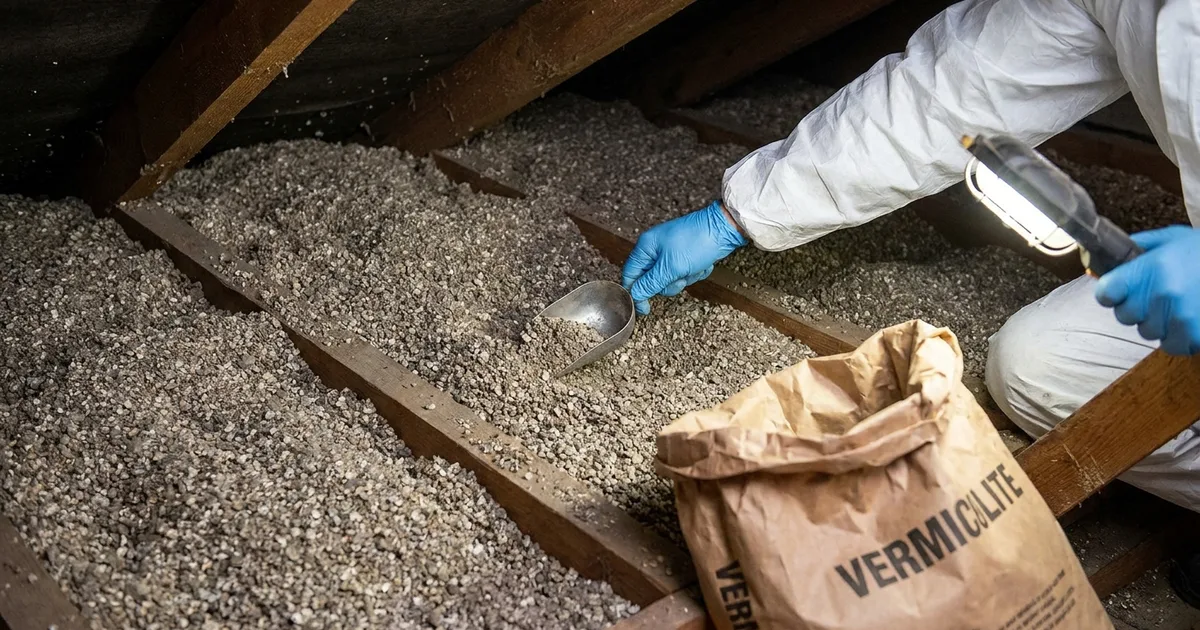
The loose golden granules in your loft have a longer history than your house. For most of the twentieth century, most of the world’s vermiculite supply came from a single mine in Libby, Montana, and that mine was sitting on top of a deposit of tremolite asbestos.
If your home was built or insulated before 1990, the loose fill poured between your loft joists could be carrying fibres from that mine. Most asbestos guides warn you about corrugated roofing and pipe lagging. Vermiculite insulation is the one people rarely get told about, which is exactly why a surveyor so often finds it during a house sale when nobody was looking for it.
Here’s the part that matters. UK law has already made the call for you. HSE guidance says treat all vermiculite insulation as an asbestos-containing material until a laboratory proves otherwise. The only real question is whether you deal with it now, on your own terms, or later when a buyer’s surveyor flags it mid-sale.
This guide gives you the full path: how to identify it, what the law actually requires, how to get it tested, and how to find a genuinely licensed contractor in your area.
What Does Vermiculite Insulation Look Like?
Before any decision, confirm what you’re actually looking at. Vermiculite insulation shows up as loose, free-flowing granules, not rolls or batts. The individual pieces are small, roughly 2 to 8mm, somewhere between an apple pip and a small pebble.
The colour is the giveaway. Expect golden-brown, silver-grey, or a light olive-tan. People often describe it as “expanded mica” or “silver and gold cornflakes.” Pick a granule up and you’ll see it’s lightweight, flaky, and visibly layered, almost laminated. That’s different from mineral wool, which is fibrous and cotton-like, and different again from loose-fill cellulose, which looks like grey paper fluff.
You’ll most often find vermiculite loose-poured directly onto the loft floor between the joists, usually 50 to 100mm deep. The loft is the classic location, and Section “Which UK Properties” below breaks down the other places it hides.
One trap to watch. If your loft has been topped up with modern mineral wool rolls, the original vermiculite may still be sitting underneath. Lift a corner and check what’s below before you assume the loft is clear.
The hard limit on all of this: looking at it can’t confirm or rule out asbestos. Only analysis at a UKAS-accredited laboratory can do that. Visual identification tells you it’s probably vermiculite. It can’t tell you whether the vermiculite is contaminated.
Why Pre-1990 Vermiculite Is a Different Category of Risk
Vermiculite itself is not dangerous. It is a naturally occurring mineral that expands up to thirty times its size when heated, which makes it a cheap and effective insulator. Clean vermiculite is still mined and used today from deposits in South Africa, China, Zimbabwe, and Brazil. So when people ask whether vermiculite insulation contains asbestos, the honest answer is: not all of it does.
The problem is the source. The Libby, Montana mine, run by W.R. Grace & Co., supplied over 70% of the world’s vermiculite from 1919 to 1990. That single deposit was co-located with tremolite, winchite, and richterite asbestos. These are amphibole fibres, the type considered more hazardous than the white chrysotile asbestos most people have heard of. The contamination travelled inside the product, into lofts across the UK and the US.
The principal consumer brand was Zonolite Attic Insulation. If your loft holds old loose-fill insulation and you do not know the brand, the sensible default is to assume it is Zonolite until a test says otherwise. That is the practical link between vermiculite insulation and asbestos: it is about where and when the material was made, not what it looks like.
W.R. Grace closed the Libby mine in 1990. The EPA later called Libby “the worst case of community-wide exposure to a toxic substance in United States history.” More than 400 townspeople died from the contamination and around 1,200 developed asbestos-related abnormalities. You can read the EPA’s account on its vermiculite insulation guidance page.
The reason this is a live issue in 2026, not a piece of history, is latency. Asbestos diseases take 20 to 40 years to appear after exposure. Insulation installed in the 1960s, 70s, and 80s is producing cases now. The UK banned all asbestos use in November 1999, but the material already in our buildings did not go anywhere.
Which UK Properties Are Most at Risk?
Vermiculite loft insulation went into UK properties built or retrofitted roughly between 1955 and 1990, with the heaviest use from 1960 to 1985. If your property sits in that window and still has its original loft insulation, treat it as a candidate.
By far the most common place is the loft floor, loose-poured as thermal fill between the joists. That’s where the overwhelming majority turns up. Beyond the loft, it shows up in cavity walls in some 1960s and 1970s builds, in lightweight floor screeds in commercial and industrial buildings, in a few acoustic ceiling-tile systems, and in some boiler and pipe lagging.
Crucially, age beats location as a predictor. Vermiculite went into terraces, semis, and detached homes alike during the post-war housing boom, so it’s found right across the UK rather than in any one region. A recently re-roofed or re-insulated property isn’t automatically in the clear either. If the build predates 1990, the original fill may still be sitting under whatever was added on top.
What UK Law Requires (This Is Not Optional)
The legal position on vermiculite is far more clear-cut than most contractor guides admit, and it decides exactly what you can and cannot do yourself. Here’s what the rules actually require.
HSG264, the HSE’s “Asbestos: The Survey Guide,” states plainly that surveyors must presume vermiculite insulation is an asbestos-containing material (ACM) unless laboratory evidence proves otherwise. That is the formal UK default. Guilty until tested innocent. You don’t get to assume yours is clean because it looks fine.
The Control of Asbestos Regulations 2012 (CAR 2012) set the rules for what happens next. Licensable asbestos removal work must be carried out by an HSE-licensed contractor. Carrying out that work without a licence is a criminal offence, not a technicality. If you want the detail on the tiers involved, read what an HSE standard licence involves.
Two points people get wrong. First, this applies to your own home, not just commercial buildings. “It’s my house, I can do what I like” has no legal force where suspected ACM is concerned. Second, because HSG264 says treat untested vermiculite as ACM, the ordinary rules of home improvement do not apply to it. DIY removal, hiring a skip, bagging it for the bin: none of that is lawful for material that hasn’t been cleared by testing.
The good news is that finding a professional isn’t the hard part. The HSE CONIAC register holds roughly 457 licensed removal contractors and 258 licensed surveyors as of early 2026. The hard part is simply knowing you need one before you reach for a vacuum.
How to Get Vermiculite Insulation Tested in the UK
Testing is the gate everything else passes through. Here’s the exact sequence you can act on this week.
1. Do not disturb it. No vacuuming, sweeping, bagging, or walking through it. Undisturbed vermiculite that is sealed away from your living space poses little immediate risk. The danger is fibre release, and disturbance is what releases fibres.
2. Commission an asbestos management survey from a UKAS-accredited asbestos surveyor. Not a general building surveyor, and not a mail-order self-test kit. A proper surveyor takes the sample using wet methods that suppress fibre release, which matters with loose granular material more than almost anything else.
3. The laboratory does the science. Analysis uses polarised light microscopy (PLM) or transmission electron microscopy (TEM) to identify the fibre types present and quantify how much is there. This is what turns “probably vermiculite” into a documented yes or no on asbestos.
4. Budget realistically. A residential vermiculite survey in the UK typically runs £100 to £300, depending on how many samples are taken and the laboratory turnaround. Some surveyors split the site visit fee from the lab fee, so ask for the full cost upfront.
5. Expect a short wait. Standard results come back in 5 to 10 working days, with 24 to 48 hour fast-track available for an extra fee.
If the result is negative, keep the certificate. A buyer’s solicitor will likely ask for it. If it is positive, you move to the removal or encapsulation decision.
Removal or Encapsulation: Which Option Is Right?
If asbestos is confirmed, or if the material hasn’t been cleared by testing, both options below require an HSE-licensed contractor. That is the fixed point. What changes is which approach fits your situation, and you should walk into that conversation knowing the difference rather than taking whatever the contractor prefers to sell.
Removal is the right call when:
- Renovation or building work will disturb the loft. Stripping it out before the work starts is far cheaper than handling a contaminated site mid-project.
- You are selling. Buyers’ solicitors and mortgage lenders increasingly want a test certificate and, where asbestos is confirmed, proof it has been dealt with.
- Asbestos content is confirmed and significant.
- The loft is in regular use for storage, access, or living space.
Encapsulation can be appropriate when:
- The vermiculite is genuinely undisturbed, well sealed from the rooms below, and going to stay that way.
- Budget rules out full removal right now. A documented encapsulation as an interim measure beats doing nothing.
- A risk management plan is in place and recorded in the building’s asbestos register, which is a legal requirement for non-domestic premises under CAR 2012.
Encapsulation is lower-risk management work, and a contractor holding an HSE maintenance licence can often carry it out, whereas full strip-out is standard licensed work. Confirm which licence type the job actually needs before you sign anything.
A proper asbestos vermiculite removal follows a set process: wet suppression of fibres, HEPA vacuum extraction, double-bag containment, disposal as hazardous waste at a licensed facility, and a mandatory air clearance test at the end. Costs swing widely with volume, access, and location, so there’s no honest national figure to quote. Don’t accept any price without an on-site assessment, and treat a suspiciously cheap quote as a question to ask, not a bargain to grab.
How to Find an HSE-Licensed Asbestos Contractor in Your Area
Not every firm that calls itself an asbestos removal contractor holds an HSE licence. The distinction is legal, and it matters for your insurance too. Hiring an unlicensed firm for licensable work puts the liability partly on you, the person who commissioned it.
The HSE CONIAC register is the authoritative list of every licensed contractor and surveyor in the country. Checking it before you hire is free and takes minutes. Asbestos Register UK lists every CONIAC-registered firm, all 457 removal and 258 surveying licences, searchable by county and region. It is the full register, not a curated shortlist of whoever paid to appear.
So whether you’re in London, the North West, or Scotland, you can search by your own county rather than guessing from a national advert. Our county comparison pages go a step further and rank the contractors in each area by licence type and customer ratings.
When you request quotes, ask three things every time. Get the HSE licence number. Confirm the licence type, whether standard, maintenance, or scaffolding. And ask directly whether the quote includes the air clearance test, because it should. Don’t appoint on price alone. A failed clearance means the job isn’t finished and the cost repeats.
Your next move is straightforward. If you haven’t had the insulation tested, that is step one. If a test has already confirmed asbestos, you’re ready to line up a licensed contractor for removal or encapsulation. Either way, the foundation is verifying an HSE licence, which is precisely what Asbestos Register UK is built to help you do. Search by your county, check the licence, and deal with what is in your loft before it surfaces on someone else’s terms.
For the official regulatory background, the HSE’s asbestos pages cover CAR 2012 and the survey guidance in full.