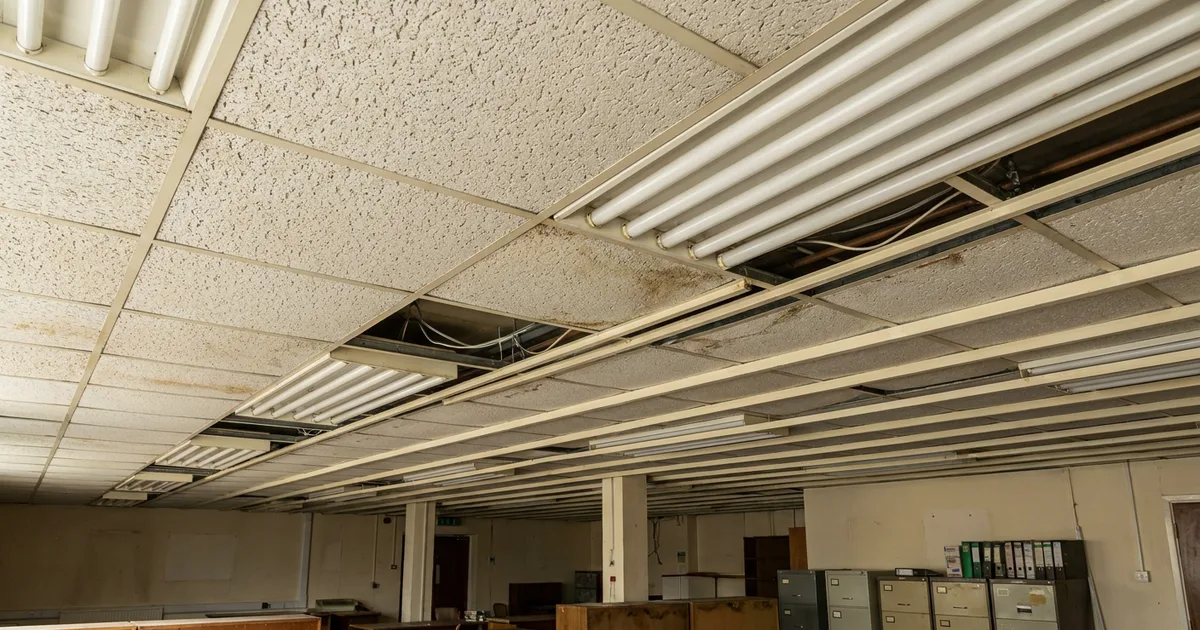
Asbestos ceiling tiles aren’t going to make you ill today. That’s what makes them genuinely dangerous. Disturb them during a renovation this summer and the consequences could surface as late as the 2060s, long after you’ve forgotten the tiles were ever there.
The gap between breathing in a fibre and developing an illness runs anywhere from 15 to 60 years. The damage from a careless afternoon with a drill doesn’t announce itself. It waits, often for decades, which is exactly why people underestimate it.
There’s a second thing most homeowners don’t know. Removing asbestos insulating board (AIB) ceiling tiles with an unlicensed contractor is a criminal offence under the Control of Asbestos Regulations 2012. Not a quiet fine-and-forget matter. A prosecutable one.
This guide covers the full journey: how to tell whether your ceiling tiles are a candidate, how professional testing actually works, when the law requires removal rather than management, what the job costs, and how to verify that the contractor you hire is legally allowed to do the work. Asbestos tiles are manageable once you know the steps. The trouble starts when people skip them.
Not All Asbestos Ceiling Tiles Are the Same, and the Difference Matters
Before you do anything else, you need to know that “asbestos in ceiling tiles” isn’t one single problem. There are several distinct materials, and the type you have decides who is legally allowed to remove it. Getting this wrong is the most expensive mistake a homeowner makes.
Asbestos insulating board (AIB) tiles are the highest-risk and most common type in UK buildings. They’re a composite containing roughly 25 to 40% asbestos, usually amosite (brown) or crocidolite (blue), the more hazardous fibre types. AIB is friable, meaning it crumbles and releases fibres easily when damaged. Removing AIB always requires an HSE-licensed contractor. There are no exceptions to that rule. You’ll typically find AIB as 600×600mm or 1200×600mm panels dropped into a suspended metal grid. Nine times out of ten, when a homeowner has a genuine asbestos ceiling problem, this is the material they’re looking at.
Sprayed asbestos coatings, known in the trade as limpet, were applied directly to concrete ceilings for fireproofing and acoustic control. These can contain up to 85% asbestos, the highest concentration of any building product. They’re mostly found in 1960s and 1970s commercial and industrial buildings rather than homes, and they always require licensed removal.
Textured coatings such as Artex aren’t tiles at all, but they get confused with them constantly. Artex applied before 2000 may contain up to 3% chrysotile (white) asbestos. The content is low and the fibres are tightly bound, so this is lower-risk work that usually falls outside the licensing requirement, a materially different legal position to AIB.
Asbestos cement tiles turn up in outbuildings and garages. They contain around 10 to 15% asbestos, are non-friable, and sit at the lower end of the risk scale, but they still need professional assessment before anyone touches them.
How to Identify Asbestos Ceiling Tiles (and Why Visual Checks Are Only a Starting Point)
Knowing how to identify asbestos ceiling tiles starts with the building, not the tile. Age is the single strongest indicator. Asbestos wasn’t fully banned in UK building products until 1999, so any ceiling tile installed before that date could contain it. Tiles from the 1960s through the 1980s carry the highest risk, because that’s when suspended grid ceilings spread through offices, schools, and homes.
Size. Classic AIB grid tiles measure 600×600mm or 600×1200mm. Older residential tiles may be 12×12 inch (305×305mm) imperial squares. Imperial dimensions in a pre-1990 property are a meaningful signal.
Colour and texture. Asbestos ceiling tiles are usually white, cream, or off-white, with a stippled, pinhole, or fine-grain surface. Some show a faint soft-fibre appearance under the surface coating.
Feel. AIB tiles have a chalky, brittle quality next to the denser mineral fibre tiles sold today. They feel softer and lighter.
The grid. If the suspension system looks pre-1990s and the tiles match the description above, treat the whole ceiling as suspect rather than assuming a few tiles are fine.
Condition. Damaged, crumbling, or water-stained tiles are higher risk regardless of type, because water degrades the binder that holds the fibres in place. A brown stain spreading across a 1970s tile is a reason to get it checked, not to wait.
Here’s the hard limit on all of this. A tile containing asbestos and a tile containing none can look identical. Roughly 1.5 million UK buildings still contain asbestos in some form, and you can’t pick out which tiles are dangerous by eye. Never break, snap, or drill into a tile to inspect it. That’s precisely the action that releases fibres into the air you’re breathing.
How Professional Asbestos Testing Works (and When You Need It)
If you’ve ticked several of the boxes above, the responsible next step is testing, not a judgement call. The only way to confirm asbestos is laboratory analysis at a UKAS-accredited lab, using polarised light microscopy (PLM) or, for finer work, transmission electron microscopy (TEM). A surveyor can’t tell you for certain by looking, which is why a sample has to go under a microscope.
There are two survey types, and the one you need depends on what you plan to do. A management survey (a Type 2 survey) suits an occupied property where the tiles are staying put and are unlikely to be disturbed. A refurbishment and demolition (R&D) survey (a Type 3 survey) is the one required before any renovation or ceiling work in a pre-2000 building.
This is where a recent change matters. A 2025 regulatory update extended the R&D survey requirement to cover all ceiling work in pre-2000 buildings, including repainting. Even minor decoration now triggers the legal survey requirement before work can start. If your decorator wants to roller a fresh coat over a 1970s suspended ceiling, the survey comes first.
The process itself is straightforward. The surveyor takes a small sample using wet wipe suppression and the right PPE, seals the sample point afterwards, and sends the material to a UKAS lab. Results usually come back in 3 to 5 working days. You receive a written report setting out the location, condition, asbestos type, and a risk assessment. That report is the document your contractor needs before any removal can legally begin.
Don’t be tempted to take the sample yourself. Sampling is controlled work under the Control of Asbestos Regulations 2012 (CAR 2012) and needs proper suppression and protection. A management survey costs around £200 to £400, an R&D survey £300 to £600, and individual lab analysis runs £30 to £80 per sample. Against the cost of getting exposure wrong, it’s the cheapest part of the whole job.
What Happens When Asbestos Ceiling Tiles Are Disturbed
An intact asbestos ceiling tile in good condition poses minimal risk. The fibres are locked into the board and aren’t going anywhere. The danger is entirely about disturbance. Drilling a fixture into a tile or cutting one during a renovation releases microscopic fibres into the air. So do the failure cases: water damage that breaks the material down, a partial ceiling collapse, or a DIY removal attempt.
Once inhaled, those fibres lodge in the lining of the lung and can cause serious disease. The most feared is mesothelioma, a rare cancer of the lung or abdominal lining that’s almost always fatal and almost exclusively caused by asbestos. More than 2,700 new cases are diagnosed in Great Britain every year. Asbestos also drives lung cancer, asbestosis (progressive scarring of the lung tissue), and diffuse pleural thickening, which restricts breathing.
The HSE estimates around 5,000 deaths a year in Great Britain from asbestos-related disease. The latency period of 15 to 60 years is what makes the risk so easy to dismiss, because the person disturbing a ceiling today won’t feel anything for decades. The HSE asbestos FAQ sets out the health picture in full. The point is simple: the precautions exist because the consequences are delayed, not because they’re small.
Remove or Manage? What the Law Actually Requires
Most homeowners assume asbestos means rip it out now. The law doesn’t agree. Under the Control of Asbestos Regulations 2012, the formal duty to manage asbestos falls on non-domestic buildings under Regulation 4. In a private home there’s no legal duty to survey at all. But any contractor working in the property has to check for asbestos before they start, and if they find asbestos-containing materials (ACMs), the work stops and a proper assessment follows.
Management in place is the right response when the tiles are in good condition, are unlikely to be disturbed, and their location and condition are recorded in an asbestos management plan. A stable, intact suspended ceiling in an occupied office is often safer left alone and monitored than ripped out. Removal disturbs material that was doing no harm.
Removal becomes the right call when tiles are significantly damaged or deteriorating, when planned refurbishment or demolition will disturb them, or when the duty holder decides removal is the safer long-term option. Damaged AIB isn’t a candidate for management. It’s a candidate for a licensed contractor. And the 2025 R&D survey rule still applies here: even minor ceiling work in a pre-2000 building needs that survey before anyone starts. Once removal is the decision, the type of tile you identified at the start determines the licence the contractor must hold.
Asbestos Ceiling Removal: Costs, Licensing, and What to Expect
Two things decide an asbestos ceiling job: who’s legally allowed to do the work, and what it costs. Most competitor guides skip both. Start with the law, because it’s the part that can land you in court.
On licensing, the line is clear. AIB ceiling tile removal always requires an HSE Asbestos Standard Licence. A standard licence covers the full removal of friable, higher-risk materials including AIB, and using an unlicensed contractor for this work is a criminal offence under CAR 2012. Artex and other textured coatings are different. That work is usually non-licensed but still notifiable, and a contractor holding a maintenance licence can carry out limited lower-risk asbestos work of that kind. Knowing which category your tiles fall into is what tells you which licence to ask for.
The removal itself follows a controlled sequence. The contractor erects an enclosure around the work area using polythene sheeting and a negative pressure unit so fibres can’t escape. Workers wear full PPE: respiratory protection, disposable coveralls, and gloves. Tiles are removed, double-bagged in labelled hazardous waste sacks, and taken to a licensed disposal facility. Air monitoring runs before, during, and after the work, ending with a four-stage clearance, the decontamination and air-testing process that confirms the area is safe before the enclosure comes down. A clearance certificate is issued at that point.
On price, these are the UK ranges to expect for asbestos ceiling removal cost in 2025 and 2026.
| Item | Typical cost |
|---|---|
| Management survey | £200 to £400 |
| Refurbishment and demolition (R&D) survey | £300 to £600 |
| UKAS lab analysis (per sample) | £30 to £80 |
| Air monitoring (pre and post removal) | £200 to £1,000 |
| AIB ceiling tile removal (licensed) | £40 to £75 per m² |
| General ceiling tile removal (licensed) | around £225 per m² |
| Encapsulation (alternative to removal) | around £33 per m² |
| Asbestos waste disposal | £50 to £200 per tonne |
For a typical residential room with an AIB ceiling of around 15m², a realistic all-in figure including survey, air testing, removal, and disposal lands between £900 and £1,500. That’s the all-in figure a homeowner should budget for a single-room job. Always get at least three quotes, and only from HSE-licensed contractors. A quote that comes in far below the others usually means a corner is being cut somewhere you can’t see.
How to Verify Your Contractor Is HSE-Licensed
This is the step most homeowners skip, and it’s the one that protects you. Every HSE-licensed asbestos contractor holds a current licence issued by the Health and Safety Executive. Check it before you sign anything or pay a deposit.
The CONIAC register is the official source. It lists every current licence holder with their licence number, the licence holder name, the scope of work they’re permitted to carry out, and the expiry date. Our directory at theasbestosregister.co.uk is built directly from that register and lists all 457 licensed removal contractors, searchable by region and county. It’s the only consumer-facing directory that shows every licensed contractor rather than just the members of one trade association. London homeowners can browse verified contractors in the London region, where pre-1980 properties with suspended ceiling systems are most concentrated, and North West homeowners can do the same across the older Manchester and Liverpool building stock.
When you check a contractor, confirm the licence type covers your specific work (standard for AIB, not just maintenance), confirm the expiry date is in the future, and confirm they actually carry out ceiling tile removal. Treat three things as red flags: any contractor who can’t give you a licence number, anyone who quotes without insisting on a survey first, and anyone who offers to remove tiles with no air monitoring.
Asbestos ceiling tiles aren’t frightening once you know the order of play: work out what type you’ve got, get it tested before anyone touches it, decide with the surveyor whether to manage or remove, and only ever hand the job to a licensed contractor. There’s one rule that protects you more than any other, and it’s the simplest. Check the licence before the work starts. Every time.