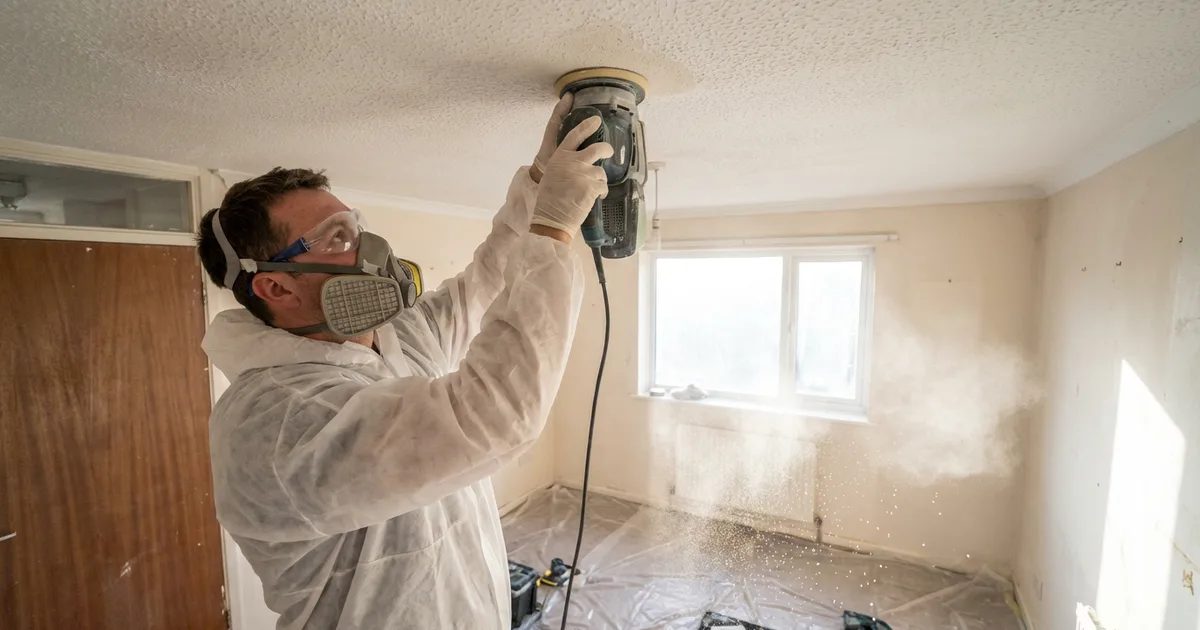
You’ve just put the sander down and the word “asbestos” is front of mind. Maybe you Googled it mid-job. Maybe someone else pointed it out. Either way, you’re reading this because you want to know if you’ve done yourself serious harm.
The official GOV.UK assessment is that the risk of serious long-term health effects from a single brief exposure is “very low.” That’s the government’s own language, not ours.
But “very low” depends entirely on what you were sanding, for how long, and in what kind of space. Sanding Artex for two minutes in an open room is not the same as power-sanding old floor tiles for half an hour in a sealed bathroom.
If you’re still in the room with the dust, skip straight to the next section. Stop work, close the door, and come back to this page once you’re out.
First: Stop Work, Leave the Room, and Do These Three Things
If you’re still near the material you were sanding, stop now. Don’t finish the job, don’t tidy up, don’t run a vacuum. Just stop.
Leave the room and close the door behind you. The goal right now is containment, not ventilation. Closing the door stops dust drifting into the rest of the house. Keep everyone else out too, especially children and pets.
If your clothes are visibly dusty, remove them and bag them. Don’t shake them out. If you can shower, do so by rinsing rather than scrubbing. Don’t dry-wipe your skin or hair.
Do not use a standard vacuum cleaner on the dust. Domestic vacuums don’t have fine enough filters. They blow asbestos fibres straight back into the air and spread them through the room. Leave the mess alone for now.
After a few hours, open the windows in the affected room to let any remaining airborne fibres disperse. Don’t re-enter the room to use it normally until you’ve worked through the steps below.
Was It Actually Asbestos? What You Were Most Likely Sanding
Before worrying about exposure levels, confirm whether the material could contain asbestos at all. The UK banned all asbestos in 1999, but an estimated 1.5 million UK buildings still contain it. If your property was built or refurbished before 2000, some materials are strong candidates.
The most common scenario is Artex and textured coatings. Pre-1985 Artex commonly contained chrysotile (white asbestos) at roughly 2% by weight. Between 1985 and 1999 it may or may not contain asbestos. Post-1999 products are clean. If you were sanding a textured ceiling in a pre-1985 house, this is the most likely culprit. Sanding walls before redecorating raises a related question: some pre-1980 textured papers used asbestos fibre, and the backing layer or adhesive paste under woodchip and Anaglypta can contain it too — our asbestos wallpaper guide covers how to tell.
Were you working on a floor? Vinyl and thermoplastic tiles laid before 1980 often contained asbestos. Power-sanding these tiles, or grinding the black adhesive underneath them, is considered a high-fibre-release activity.
Asbestos insulation board (AIB) is the one to take most seriously. Found in fire doors, ceiling tiles, and partition boards, it contains amosite (brown) or crocidolite (blue) asbestos at higher concentrations than Artex. These fibre types are more potent than chrysotile.
Asbestos cement in garage roofs, shed walls, and gutters is hard and bonded. It releases fewer fibres than softer materials when left alone, but power tools change that equation quickly. Pipe lagging and boiler insulation sit at the other extreme: friable (crumbly) and the highest fibre release of any common DIY material.
If you’re not sure what the material is, an accredited analyst can test a small sample. It typically costs £30 to £100 and tells you definitively whether asbestos is present and at what percentage.
How Worried Should You Actually Be? (An Honest Risk Assessment)
If you accidentally disturbed asbestos during a one-off DIY job, your actual risk depends on three variables: the material type (and specifically the fibre type), how long you were working, and whether the space was ventilated.
The GOV.UK toxicological overview states that “the risks of serious long-term health effects from a single exposure are judged to be very low.” The HSE Asbestos FAQ notes that many cases of inadvertent short-term exposure lead to “minimal exposure to fibres, with little likelihood of any long-term ill health effects.”
But “very low” is not “zero,” and the number shifts depending on your scenario.
| Scenario | Risk Level | Key Reason |
|---|---|---|
| Sanded Artex briefly (< 5 mins) in large ventilated room | Very low | Low concentration (2%), short duration, fibres disperse |
| Power-sanded floor tiles 30+ mins in small closed room | Low to moderate | Higher fibre release; enclosed space concentrates fibres |
| Cut or sanded AIB (insulation board, fire door panel) | Moderate | Amosite/crocidolite content; higher potency fibres |
| Drilled or ground asbestos cement (garage roof) | Low | Bonded material, relatively stable |
| Disturbed pipe lagging or friable loose-fill insulation | Moderate to high | Highest fibre release of common DIY materials |
The fibre type matters. Chrysotile (white asbestos, the type found in Artex) is cleared more efficiently by the lungs and is considered “generally less potent” than amphibole types. Amosite (brown) and crocidolite (blue) are longer, more rigid fibres that persist in lung tissue for longer. They carry a higher mesothelioma risk.
You will have no symptoms now. That is expected and normal, not a sign that everything is fine.
Asbestos-related disease does not appear immediately. The Health and Safety Executive (HSE) says it can take 15 to 60 years for any symptoms to develop after exposure. For context, Cancer Research UK puts mesothelioma at around 2,200 deaths every year in the UK; our guide on how long asbestos takes to cause illness sets out the timelines by disease. The UK takes asbestos seriously because the toll is real. But those deaths overwhelmingly result from sustained occupational exposure over years or decades, not from a single afternoon of DIY.
The HSE’s workplace exposure limit (WEL) is 0.1 fibres per cm³ as a 4-hour time-weighted average. The HSE itself states that this is not a “safe” level. It is a workplace control limit, not a health threshold. Risk is cumulative and dose-related. One exposure is not nothing. It is just very unlikely to cause harm on its own.
What to Do if You Sanded Asbestos: Your 48-Hour Action Plan
Whether or not you’ve confirmed it’s asbestos, these steps cover the next 48 hours.
Do not return to work on that material. Whether it’s the ceiling, the floor, or the pipe. Leave it alone until testing confirms it is asbestos-free, or until a licensed contractor has assessed it.
Get the material tested. An accredited asbestos analyst can take a small sample, roughly the size of a 50p coin, from an inconspicuous area. The cost is typically £30 to £100 and results come back within a few working days. This single step tells you whether you were actually exposed to asbestos and at what concentration. If the test comes back clear, the worry ends there. For a full breakdown of survey options and what drives the cost, see our guide on asbestos survey costs.
Contact your GP. Not because you need emergency treatment. Asbestos does not cause acute illness. You are contacting them to get the exposure formally documented in your medical record. If health issues develop decades from now, that record will matter. The next section gives you the exact words to use.
Do not use the room as normal until either testing confirms no asbestos, or a contractor has professionally cleaned it.
If asbestos is confirmed present, do not attempt cleanup with a domestic vacuum or damp cloth. Neither captures asbestos fibres. Do not continue the DIY work that caused the exposure. Engage a licensed contractor for professional assessment. Depending on the material’s condition and scope, they will recommend encapsulation (sealing it in place) or removal.
What to Tell Your GP (Use This Script)
The HSE explicitly recommends informing your GP about any potential asbestos exposure so it is documented in your medical record. You don’t need to explain the science. You just need to give them four pieces of information: when it happened, what the material was, how long you were exposed, and whether you were wearing any protection.
“I want to let you know I may have been exposed to asbestos during DIY work on [date]. I was sanding [material, e.g. Artex ceiling / old floor tiles] at home in [room]. I was in the room for approximately [duration] and [was / wasn’t] wearing a dust mask. I’d like this recorded in my notes in case it becomes relevant in the future.”
Your GP will likely note the exposure for future reference. They may ask about symptoms such as cough or breathlessness. You almost certainly don’t have any, and that is expected.
Don’t be surprised if they don’t refer you for an X-ray. The HSE’s official FAQ states: “We do not advocate routine X-rays following inadvertent exposure, since asbestos damage develops slowly and is not immediately visible on imaging.” That is not your GP dismissing you. It is them following the correct clinical guidance. The record in your notes is what matters.
When You Need a Licensed Contractor (And Why DIY Cleanup Makes It Worse)
Standard domestic vacuum cleaners cannot capture asbestos fibres. The filter pores are too large. Running a vacuum over asbestos dust blows fibres back into the air and can spread them from one room to the rest of the house. Wet wiping may settle fibres temporarily but does not remove them. Professional asbestos cleaning uses H-type (HEPA) vacuums and specialist decontamination procedures. There is no consumer-grade shortcut.
The Control of Asbestos Regulations 2012 (CAR 2012) classifies asbestos work into three categories: licensed, notifiable non-licensed (NNLW), and non-licensed. Work on higher-risk materials like AIB, pipe lagging, or sprayed coatings requires an HSE licence. It is a criminal offence to carry this out without one. Other materials, such as limited work on asbestos cement, can be handled by trained but unlicensed operatives.
If you’re a homeowner who accidentally sanded Artex in your own home, you are not classed as an “employer” under CAR 2012, so there is no criminal liability on you for the accidental asbestos exposure. But any contractor you hire to clean up or remove the material is subject to the full regulatory regime. Make sure they hold the right credentials.
If the accidental exposure happened at a workplace rather than a domestic home, the employer must report the uncontrolled release of asbestos fibres to the HSE under RIDDOR (Reporting of Injuries, Diseases and Dangerous Occurrences Regulations 2013). This is mandatory, not optional.
What to look for in a contractor: a current HSE licence (for licensable materials), UKATA or BOHS P402 training as a minimum qualification standard, and the ability to conduct an air clearance test after remediation. The HSE’s CONIAC register lists approximately 715 licensed contractor companies across the UK. Always verify a contractor’s licence on the register before any work starts.
The Asbestos Register lists every HSE-licensed contractor in the UK, drawn directly from that register.
The Bottom Line
You’ve done something that feels serious. It probably isn’t, but you won’t know for certain until the sample results come back. In the meantime, the five steps above cover everything that can be done: stop work, contain the area, get the material tested, see your GP with the script above, and hire a licensed contractor if needed.
Complete them and move on. If symptoms ever develop years from now, the GP record means you have documentation from day one.