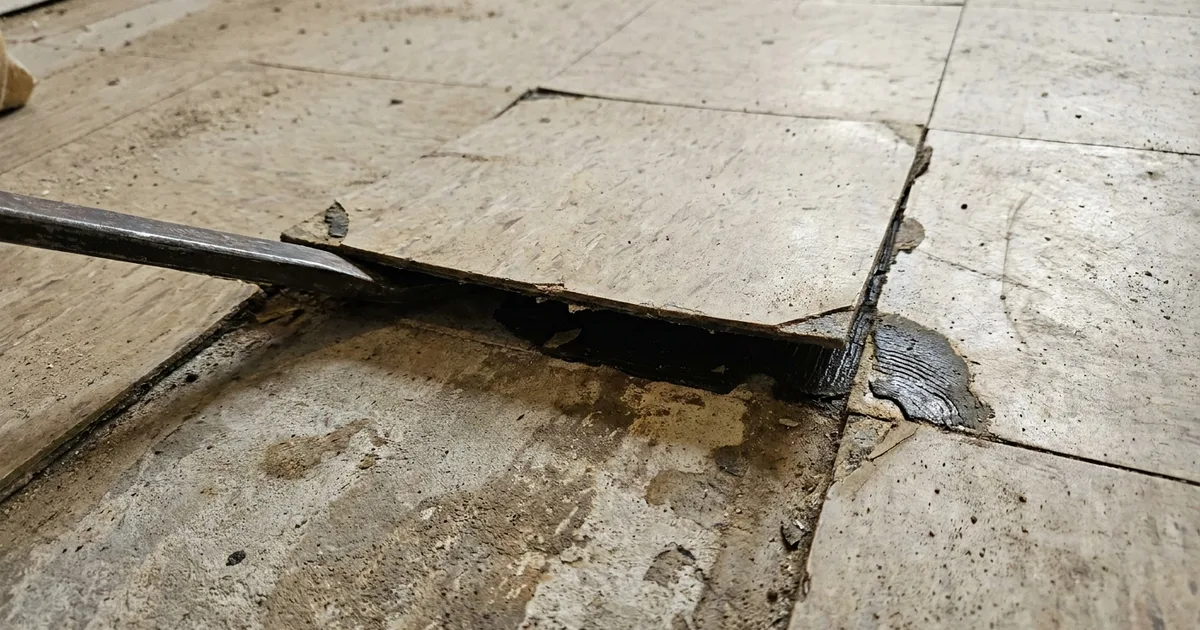
Lift the corner of an old vinyl floor tile and measure it. If it's a 9-inch square and the building went up before 1985, you're looking at the single strongest visual clue there is that it contains asbestos. And no, you can't confirm it just by looking. That gap between what a tile looks like and what it actually is runs through everything below, so screen fast here, then test before you trust it.
This post is a fast visual screen for how to tell if floor tiles contain asbestos, not a lab report. In the next two minutes you'll check your tile against every cue that matters in a UK building: size, colour and pattern, texture, the adhesive underneath it, and the age of the property. By the end you'll know whether what you've found is a genuine candidate for testing or a low priority you can park.
What you won't have is a verdict, because nobody can give you one by eye. For the full testing, removal, cost and legal detail, this guide hands off to our complete asbestos floor tiles guide at the end. Screen it fast here first, then decide whether to test.
The 2-Minute Visual Test for Asbestos Floor Tiles
Here is how to identify asbestos floor tiles at a glance, strongest cue first. Work down the list, and the more boxes a tile ticks, the stronger the case for testing it rather than dismissing it.
- Size (the strongest single cue). Asbestos vinyl tiles came almost exclusively in imperial squares. The 9×9 inch (229×229mm) is by far the most common; 12×12 and 18×18 also exist. Modern flooring is almost never sold in these sizes, so a 9-inch square lifted from under carpet or laminate is the clearest flag you'll find without a lab. Measure one edge at roughly 229mm and treat the whole floor as suspect.
- Colour and pattern. Look for a marbled, mottled or speckled finish, not a flat solid colour. Brown, grey, green, cream, beige and pale pastels all turn up in asbestos-era flooring. Don't trust colour alone; it's the imperial size and the marbling together that matter, not any single shade.
- Thickness and brittleness. These tiles are thin and brittle. They snap or scrape up in hard chunks rather than flexing like the pliable modern vinyl sold today. A tile that shatters at the edge instead of bending is behaving like an asbestos-era product.
None of these three cues is proof on its own. A 9-inch marbled tile in a 1970s house is a strong reason to stop and test. A modern flexible tile in a plainly post-2000 kitchen extension is a much lower priority. The visual test tells you where your tile sits on that scale, and nothing more.
There's a fourth cue most guides mention only in passing, and it can be a red flag even if the tile itself turns out to be fine.
The Black Mastic Adhesive Is Its Own Red Flag
The black bitumen or mastic adhesive used to stick these tiles down often contains asbestos in its own right, independent of the tile above it. That changes what you're testing. A thick black adhesive layer revealed under a lifted tile is itself a reason to stop, even if the tile later comes back clear.
That black bitumen has its own name in the trade, cutback adhesive, and it was mixed with asbestos on plenty of floors laid in the same decades as the tiles above it. So people find a clean tile, breathe out, and forget the sticky black layer they scraped through is a separate material carrying its own risk. Test both, or you've only answered half the question.
The practical instruction is simple. If you've already lifted a tile to inspect it, stop disturbing the adhesive layer any further until it's been assessed. Don't scrape it, don't sand it, and don't try to lever the rest of the floor up to see more. When you arrange testing, sample the adhesive as well as the tile, not just one of the two.
Does Your Property's Age Match the Asbestos Era?
The build date is a second, independent screening layer that either raises or lowers your concern before you pay for a single test. Asbestos flooring was a standard UK building product from the early 1950s until 1985, fitted across homes, schools and workplaces because it was durable, heat resistant and cheap. Tiles from 1960s and 1970s houses sit squarely in that window.
The legal timeline sharpens the picture. Blue asbestos (crocidolite) and brown asbestos (amosite) were banned in UK law in 1985. Asbestos was then banned from all new construction on 24 November 1999. Anything laid before that final date could contain it, and anything laid before 1985 sits in the highest-use period, before the first material bans started narrowing what could legally go into a floor.
The rule of thumb for you is this. If the property, or the specific room or extension, had its flooring laid before 2000, and especially before 1985, treat any old square tile found under carpet or laminate as a genuine testing candidate rather than a curiosity. A newer build lowers the odds. It doesn't rule asbestos out on its own, because reclaimed and left-over tiles were sometimes fitted years after they were made.
Tick every box above and you still don't have an answer. Here's why.
Why Looking Safe Doesn't Mean It's Safe
Asbestos fibres are microscopic. You can't see them, and you can't confirm their presence by eye, full stop. A tile that contains asbestos and a tile of the same age that contains none can look completely identical. There's no shade, no pattern and no texture that settles it, because the fibres doing the damage are far too small to register in anything you can hold up to the light.
Our own detailed guide puts it plainly: a chrysotile (white asbestos) tile and a non-asbestos tile can look identical, and only laboratory analysis can confirm which is which. The visual cues narrow the odds. They never close the question.
The uncomfortable part is what that means for both outcomes. Passing every cue above, the right size, the marbled finish, the black mastic, the pre-1985 build, is a reason to test, not a reason to relax. And failing every cue isn't a clean bill of health either. It simply pushes testing down your priority list. The only thing that turns a strong suspicion into a fact is a sample under a microscope.
So if your eyes can't settle it, the sensible question is what can, and what that costs.
What to Do Next: DIY Test Kit vs a Licensed Surveyor
Testing is cheaper than most people expect, which is exactly why guessing is a poor trade. A single UKAS-accredited lab test of a physical sample typically costs around £30 when arranged through a surveyor. A full asbestos survey, the kind needed ahead of most licensed removal work, runs roughly £200 to £500 depending on the size of the property and the scope.
DIY test kits exist and are cheaper as a first step, but the trade-off is real. The sample still has to be posted to a UKAS lab for confirmation, so you're not skipping the lab, only the surveyor. And taking the sample yourself carries its own fibre-disturbance risk if done carelessly, which is the whole reason a licensed surveyor is the safer default for anyone untrained. Someone who samples floors for a living knows how to suppress dust, seal the sample point and avoid making a bigger problem than the one you started with.
If a test comes back positive and the material needs removing, that becomes licensed work. A contractor holding an HSE Standard licence covers the removal of higher-risk asbestos materials, and using an unlicensed contractor for licensable work is a criminal offence. You can find verified, HSE-licensed contractors and surveyors near you through our directory, whether you're in Kent, Hampshire or anywhere else in the UK.
For what actually happens after a positive result, the removal cost ranges, the licensing requirements, the disposal rules and the full decision guide, read our complete guide to vinyl and asbestos floor tiles. This post deliberately stops at identification and testing so it stays a two-minute screen. That guide picks up where this one ends.
Screen your tile in under two minutes with the checklist above. Just remember that matching the checklist is the start of the process, not the end of it. The cheapest, fastest way to turn a strong suspicion into a definite answer is a licensed surveyor who can sample and advise in a single visit, for a fraction of what getting it wrong would cost.