Asbestos encapsulation cost UK: when sealing beats removal
Sealing an asbestos cement roof costs £600–£2,500 for a typical garage or outbuilding, around 50–65% less than removal. On sound cement it is legally the simple option too. But it is not always the right call. Get the honest answer for your roof, then a free quote from a verified contractor either way.
What is asbestos encapsulation, really?
A coating that locks the fibres in place instead of taking the sheets away.
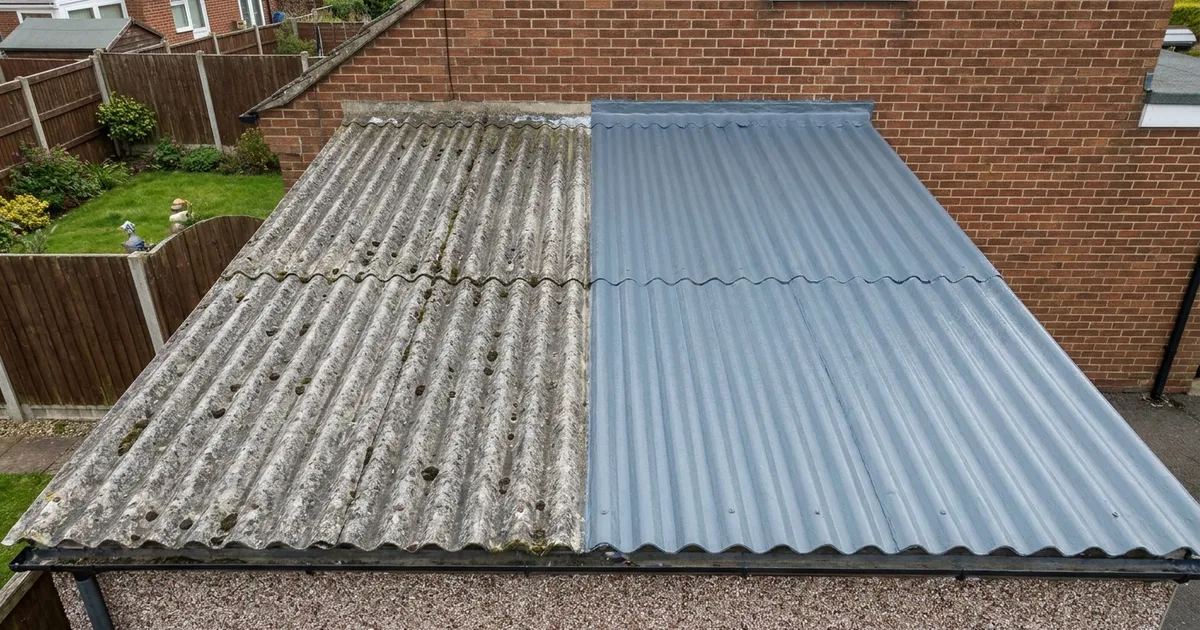
Encapsulation means a liquid-applied, impervious coating system is sprayed or rolled directly over your existing asbestos cement sheets. It binds any loose surface fibres, seals the material behind a continuous waterproof membrane, and gives the roof a fresh weatherproof skin. Nothing is stripped out. Nothing goes to a hazardous waste tip.
That is the whole trade-off in one sentence: the asbestos is still there, it is just sealed in. Removal takes the problem away permanently and costs accordingly. Encapsulation manages the problem for another 15 to 20 years at a fraction of the price.
It works because intact asbestos cement is genuinely low-risk material. The fibres are bound into a cement matrix and only become dangerous when the sheet is broken, drilled, cut, or has weathered to the point of going porous and shedding. That is why sealing is a legitimate option for a sound garage roof and a waste of money on a cracked one.
One thing to check before you go any further: encapsulation is for asbestos cement sheeting, the corrugated grey panels you find on garages, sheds, agricultural buildings and older industrial roofs. It is not the answer for textured coatings inside the house. If you are not sure what you are looking at, read does artex contain asbestos first, or book a survey.
Assess the condition
The contractor checks whether the sheets are sound enough to hold a coating. Cracked or porous material fails this test, and the classification of the job changes with it.
Prepare and clean
Moss, lichen and surface debris come off under controlled conditions. This is the step that can release fibres, so it wants trained hands and the right method, not a pressure washer.
Coat and warranty
The system is applied to spec, usually in two or more coats, and signed off with a manufacturer-backed warranty.
Asbestos encapsulation cost vs removal cost
Most pages ranking for this term are written by encapsulation companies and lead with warehouse figures. If you have a garage roof, here is your number first.
Domestic: garage roof, shed or single outbuilding
The job most people searching this term actually have.
For a full breakdown of what a licensed strip-out actually includes, see our asbestos removal cost guide and the dedicated asbestos garage roof removal page.
Commercial: warehouse, industrial and agricultural roofs
Priced the same way, but the totals are a different world. Skip this block if you are a homeowner.
Ranges compiled from published UK encapsulation contractor pricing and 2026 garage-roof replacement quotes. Treat them as a bracket, not a quote: access and scaffold requirements move a domestic price more than area does.
The headline number
Across property types, encapsulation runs 50–65% cheaper than removal and replacement. That saving is real and it is the reason the option exists. It is also the reason vendor-written pages lean on it so hard.
What those pages tend not to say is that encapsulation is not a cheap DIY seal. For context, replacing a garage roof outright with no asbestos involved runs about £950–£3,750, a figure that holds up across three independent UK trade-pricing sources. Encapsulation sits inside a comparable band because it is insured, warranted work carried out by trained operatives using a specified multi-coat system. If someone quotes you a couple of hundred pounds to "paint over" an asbestos roof with a tin of roof sealant, that is not encapsulation and it will not carry a warranty.
Prices move on access more than anything else. A single-storey garage a ladder can reach is at the bottom of the range. A roof needing scaffold, edge protection or a cherry picker climbs fast, regardless of area.
When sealing is the right call, and when it is a false economy
We do not carry out either job, so we have nothing to gain from pushing you one way. The answer depends almost entirely on the condition of your sheets.
Encapsulation makes sense when
- The cement is intact and sound. A survey scores it as being in good condition, with no cracking, delamination or heavy surface erosion.
- The building stays as it is. No demolition, no extension, no structural alterations planned that would disturb the sheets.
- The roof leaks but the structure is fine. A coating solves the water ingress and buys another 15 to 20 years.
- You want to defer the bigger bill. Spreading a £6,000 removal into a £1,500 seal now and a removal later is a legitimate cash-flow decision.
- Disruption matters. Coating intact cement sheet is a shorter, tidier job than a strip-out, a skip of hazardous waste and a re-roof.
Encapsulation is a false economy when
- The sheets are already cracked or crumbling. Coating does not repair failed material, and it will not adhere properly to a porous, degraded surface.
- The roof is heavily weathered. Decades of rain can leave cement sheet soft and shedding. A membrane over that can trap moisture and accelerate the failure underneath.
- Demolition or an extension is coming. Any of that disturbs the sealed material and forces removal anyway, now with a coating to deal with on top of the asbestos.
- You are selling soon and want it gone. Buyers and their solicitors ask about asbestos. Sealed still means present.
- You are a landlord or commercial duty holder who wants it off the register. Only removal closes the file. See the next section.
Nobody in this market has a reason to tell you this bit
An encapsulation firm will not volunteer that you do not legally need a licensed contractor. A removal firm will not volunteer that sealing is legal, compliant and far cheaper. We do neither job, so here is the whole picture.
1. Sealing sound cement is non-licensed work
Under the Control of Asbestos Regulations 2012, HSE classifies work with asbestos into three tiers. Sealing or encapsulating asbestos-containing materials that are in good condition sits in the lowest tier: non-licensed and non-notifiable.
Asbestos cement is the textbook case. It is the least friable material on the list, and HSE names asbestos cement roof sheeting explicitly among non-licensed maintenance work. So for the typical sound corrugated garage roof, no HSE licence is legally required, no notification to the enforcing authority is needed, and there is no medical surveillance or health record attached to the job.
That is genuinely good news, and it is the opposite of what most pages on this topic imply. It also has a sting: because the bar is lower, the market is easier to enter, and the quality gap between contractors is wider than it is in licensed removal.
2. Where that stops being true
Condition and material type move the job up the ladder. The moment the sheets are damaged, or the plan involves breaking cement up rather than coating it, the classification changes and so do your obligations.
| Your situation | Classification | What it means for you |
|---|---|---|
| Sealing asbestos cement in good condition (the typical garage or outbuilding roof) | Non-licensed | No HSE licence legally required. Not notifiable. No medical surveillance, no health record. Trained, competent workers and safe methods are still expected. |
| Cement that is damaged or deteriorated, or that will be substantially broken up | NNLW | Notifiable non-licensed work. Notification to the enforcing authority, a designated and signed area, three-yearly medical examinations and health records. |
| AIB, sprayed coatings, pipe lagging, loose fill or millboard | Licensed | An HSE-licensed contractor is legally required. One narrow carve-out: painting or repainting AIB that is in good condition is non-licensed. |
Source: HSE guidance on non-licensed work and notifiable non-licensed work with asbestos.
3. The duty to manage may not apply to you at all
Plenty of pages tell homeowners that sealing leaves them with a permanent legal duty and 12-monthly reinspections. For an owner-occupier that is simply not the case.
The Regulation 4 duty to manage covers non-domestic premises, such as factories, shops and offices, and the common parts of multi-occupancy domestic buildings like purpose-built flats. The dutyholder is the owner, the landlord, or whoever is responsible for maintenance and repair. Seal your own garage roof at your own house and you are not a dutyholder, and you owe no such duty.
If you are a dutyholder, the distinction matters and it is real money. Removal ends the obligation for that material: once the sheets are gone and disposed of as hazardous waste, there is nothing left on the register. Encapsulation leaves the asbestos in the building, so it stays on your asbestos register, stays in the management plan, and the coating has to be monitored and reinspected on a periodic cycle. A smaller bill now, plus an ongoing management job.
So why use a verified contractor at all?
Not because the law forces you to on a sound cement roof. Because the whole decision turns on a condition assessment, and the firm doing that assessment usually also wants to sell you the outcome. A contractor whose licence and record we have checked against the official register is one you can ask to price both options honestly, rather than one who talks you into a £6,000 removal you did not need or coats over a roof that should have come off.
How long does encapsulation last?
Long enough that most people never do the removal they were deferring.
Years of extra service life
Typical additional waterproof service life from a properly specified and installed coating system on sound asbestos cement.
Manufacturer warranty
Warranties of up to 20 years are common on correctly installed systems. Some spray-cork products carry a 15-year product warranty before a re-spray falls due.
Recoatable
A coating that starts to degrade can usually be recoated rather than triggering immediate removal, provided the asbestos cement underneath has not itself failed.
Two caveats worth knowing. Warranties cover the coating, not the asbestos cement beneath it, so a substrate that fails is a removal job whatever the paperwork says. And a warranty is only as good as the installer, which is another argument for a licensed contractor with a track record rather than the cheapest quote in the pile.
Get quotes for both options
Tell us about your roof and whether you are leaning toward sealing or removal. We will match you with up to 3 verified HSE-licensed contractors who can assess the condition on site and quote either way. Free, no obligation, and we do not do the work ourselves.
Prefer to talk it through? Call 07830 344537.
- Every contractor on the HSE register
- Encapsulation & licensed removal
- Up to 3 quotes to compare
- 100% free for homeowners
Asbestos encapsulation: the common questions
Costs, legality, lifespan and when to remove instead.