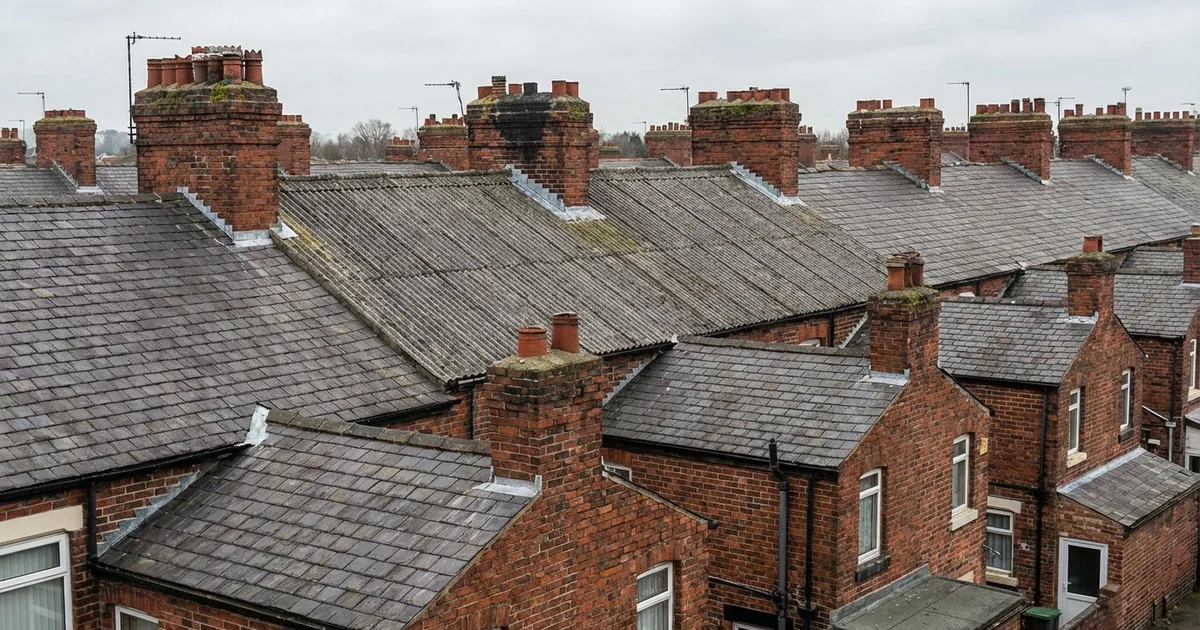
Asbestos was fully banned in the UK in 1999. It’s now 2026, and it still kills around 5,000 people here every year.
The ban didn’t make asbestos go away. It stopped new installation. What was already in the walls, ceilings, and roofs of millions of UK homes stayed exactly where it was.
Around 50% of homes built before 1999 are estimated to contain asbestos in some form. That’s an estimated 1.5 million buildings across the country. The people dying today were typically exposed decades ago, often without knowing it.
So the question isn’t really “when was asbestos banned in the UK?” The question is: where is it in your home, and what triggers the risk?
Quick Answer: When Was Asbestos Banned in the UK?
1 January 1986: Blue asbestos (crocidolite) and brown asbestos (amosite) banned under the Asbestos (Prohibitions) Regulations 1985.
24 November 1999: White asbestos (chrysotile) banned under the Asbestos (Prohibitions) (Amendment) Regulations 1999 (SI 1999/2373). This was the full ban on all asbestos types.
Critical point: The ban prohibited new installation and trading. It did not require existing asbestos to be removed from buildings.
The two-step ban is just the starting point. To understand what it means for your home, you need to know why it took 14 years to go from partial to full, and why the problem is still very much alive today.
Why Asbestos Was Still Killing 5,000 People a Year — Decades After the Ban
The HSE’s 2025 mesothelioma statistics record 2,218 mesothelioma deaths in Great Britain in 2023 alone. That’s 1,802 men and 416 women. Mesothelioma is just one of several asbestos-related diseases. The total annual death toll from all asbestos-related conditions runs to around 5,000.
Mesothelioma has a latency period of 20 to 50 years. The people dying now were typically exposed in the 1970s and 1980s, when the UK was importing 170,000 tonnes of asbestos per year. There is no cure. Average life expectancy after diagnosis is 12 to 21 months.
Three waves of asbestos deaths have already passed through the UK: industrial workers, laggers, and construction workers. The British Safety Council now warns that a fourth wave is imminent, driven by homeowners and DIY renovators disturbing legacy asbestos in older buildings. That’s the group most likely to be reading this page. The real scandal is that 25 years after the ban, there’s still no legal requirement to survey residential properties before renovation work begins.
To understand why so much asbestos ended up in UK homes in the first place, the timeline starts not in 1985 or 1999, but decades earlier, when asbestos was considered a wonder material.
Phase 1: The 1985 Partial Ban (Blue and Brown Asbestos)
The Asbestos (Prohibitions) Regulations 1985 came into force on 1 January 1986. They banned the import, supply, and use of two types of asbestos: crocidolite (blue asbestos) and amosite (brown asbestos).
Blue asbestos is the most dangerous form. Its thin, needle-like fibres penetrate deep into lung tissue and are almost impossible for the body to expel. Brown asbestos was used extensively in insulation boards and ceiling tiles throughout the 1950s to 1970s. Both were firmly linked to mesothelioma and lung cancer by the time the ban arrived.
Despite documented asbestos deaths from the 1930s onwards, why did it take until 1985 to ban even the most dangerous forms? Commercial interests and the cost of replacement materials delayed legislative action. Industry lobbied successfully to keep the most widely used type, chrysotile (white asbestos), legal, arguing it was “safer” than the other two. That claim was disputed even at the time and has since been thoroughly discredited.
The UK government chose a phased approach to minimise economic disruption, a deliberate choice that left white asbestos on the market for another 14 years.
With white asbestos still legal and still being installed in UK buildings, the partial ban had limited practical effect. That changed in 1999.
Phase 2: The 1999 Full Ban (and What It Still Didn’t Do)
The Asbestos (Prohibitions) (Amendment) Regulations 1999 came into force on 24 November 1999. So when did asbestos stop being used in the UK? This date. From that point, it became illegal to import, export, sell, supply, or use any asbestos-containing material.
Two things forced the government’s hand. The EU was moving toward a continent-wide ban, and mesothelioma deaths in the UK were climbing every year, creating legal liability that could no longer be ignored. The industry’s argument that white asbestos was “safer” had been thoroughly discredited by this point.
But here is the fact that matters most for homeowners: the 1999 ban did not require removal of asbestos already present in buildings. Materials in good condition were, and still are, legally allowed to remain in place. The current law governing asbestos management is the Control of Asbestos Regulations 2012 (CAR 2012), which sets out a duty to manage asbestos in non-domestic buildings and licensing requirements for removal work.
That estimated 1.5 million buildings figure? Most of them are homes, and most haven’t been surveyed. The ban changed the law. It did not change your house.
So what year was your home built, and what risk does that carry?
Was Your Home Built with Asbestos? A Guide by Build Year
When asbestos was used in homes across the UK matters more than when it was banned. The build year tells you what materials were standard at the time, and which parts of the building are most likely to contain ACMs.
| Home built... | Risk level | Most likely locations |
|---|---|---|
| Pre-1970 | High | Pipe lagging, ceiling tiles, insulation boards, Artex, floor tiles, soffits, garage/shed roofs |
| 1970–1985 | High (peak usage era) | All of the above, plus AIB partition walls and asbestos cement sheets |
| 1985–1999 | Moderate | Artex (pre-1990 formulations), roof sheets, some insulation. Blue and brown gone, but chrysotile still in use. |
| Post-2000 | Low, not zero | Artex specifically. Also check any renovation using salvaged or old-stock materials. |
Pre-1970: Asbestos was a standard building material. If your property dates from this era and hasn’t been fully stripped and refurbished, assume asbestos is present until proven otherwise. Pre-1970 properties are especially concentrated in London and other major cities where Victorian and Edwardian housing stock was retrofitted with asbestos products during post-war modernisation.
1970 to 1985: This was the peak. The UK was importing 170,000 tonnes of asbestos per year. Construction through this period used asbestos in everything from partition walls to soffits. Industrial-heritage areas like the North West and the West Midlands saw especially heavy use in both commercial and residential builds.
1985 to 1999: Blue and brown asbestos were off the market, but white asbestos remained legal. Artex manufactured before 1985 almost certainly contained chrysotile. Production switched to asbestos-free formulations around 1985, but old stock continued to be applied for years afterwards. The safe assumption: treat any Artex applied before 2000 as potentially containing asbestos until it has been tested. Do not sand, drill, or scrape it.
Post-2000: New-build properties should be clear. But if your post-2000 home includes an older extension, a garage with original roofing, or any renovation that reused salvaged materials, the risk is not zero. Artex is the most commonly flagged material when surveyors do find ACMs in post-2000 properties.
Knowing your home’s era narrows the risk. Knowing where asbestos typically hides lets you make smart decisions about which jobs need professional assessment.
Where Asbestos Hides in UK Homes, Room by Room
ACMs are generally safe when undisturbed. The danger starts when you drill, cut, sand, or break them, releasing microscopic fibres into the air. Before any renovation work on a pre-2000 property, check these locations.
Artex and textured coatings. The single most common ACM in UK homes. Found on ceilings and walls, particularly in properties built or decorated before 1985. Looks like a swirled or stippled surface finish. Our full guide to Artex and asbestos covers identification and testing in detail.
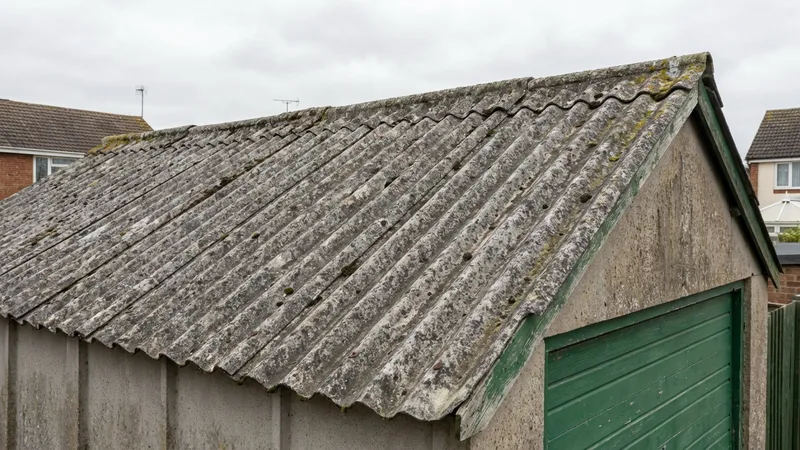
Corrugated garage and shed roofs. Grey cement sheets, extremely common on outbuildings attached to homes built between 1950 and 1980. These become fragile and prone to cracking as they weather. Breaking them releases fibres immediately.
Floor tiles. Vinyl floor tiles, particularly those bonded with black bitumen adhesive, were a standard product in pre-1980 kitchens, hallways, and utility rooms. The tiles themselves are relatively low-risk when intact, but stripping the adhesive is where the serious exposure happens. See our guide to asbestos floor tiles for the full picture.
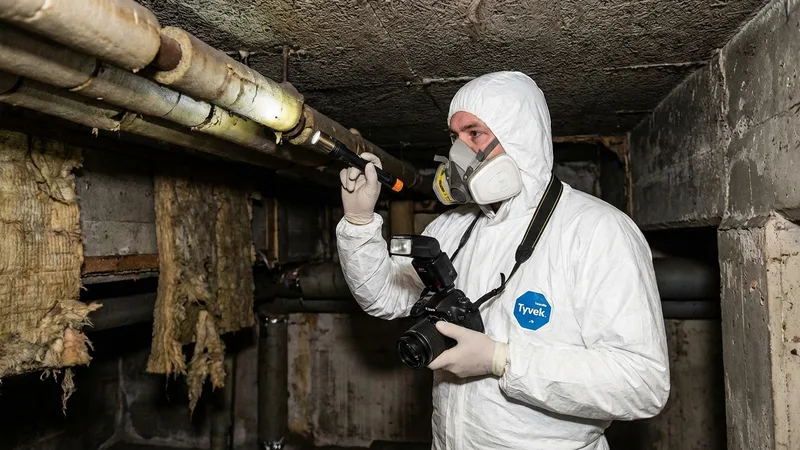
Pipe lagging. Found in boiler cupboards, basements, and around heating pipework. Looks like grey or white cotton-wool wrapping. This is one of the most dangerous ACMs when it degrades, because the fibres are loosely bound and easily released.
Soffits. The boards under roof overhangs. Often made from asbestos cement, which is relatively low-risk when intact but must not be cut, drilled, or broken without testing.
Asbestos insulating board (AIB). Used in partition walls, fire doors, lift shafts, and behind fuse boxes. AIB is the second most dangerous ACM after loose insulation because the fibres are less tightly bound than in cement products.
Ceiling tiles and bath panels. Suspended ceiling tiles from 1970s and 1980s office conversions and extensions. Bath panels and window sills are less common locations but have been documented in survey reports.
The rule is simple. Never sand Artex, drill into suspected AIB, or break corrugated cement sheets without testing first. An asbestos survey before a renovation costs £200 to £400. The alternative, mesothelioma, has no cure.
If you’re planning a renovation or have just discovered something that might be asbestos, the next question is whether to remove it or leave it, and who can legally do the work.
Should You Remove It, or Leave It Alone?
If it’s undisturbed and in good condition: Leave it alone. The law doesn’t require removal, and disturbing it to remove it creates more risk than leaving it. Asbestos-containing materials that are intact, stable, and not going to be touched during any building work are safest where they are.
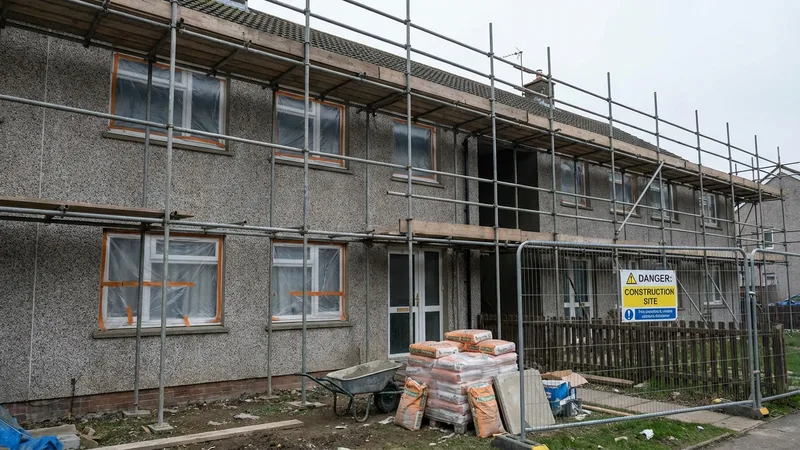
If you’re planning any renovation: Get an asbestos survey first. Before any drilling, cutting, or stripping in a pre-2000 property, a refurbishment/demolition (R&D) survey is legally required where there’s reason to suspect asbestos may be present. This costs £200 to £400 for a residential property and will tell you exactly what’s there and what precautions are needed.
If it’s damaged or deteriorating: This requires a licensed asbestos contractor. Crumbling pipe lagging, weathered garage roof sheets, and flaking AIB are releasing fibres. This is no longer a “manage in place” situation.
The licensing rule: It is a criminal offence to carry out licensable asbestos work without an HSE licence. “A friend who’s done it before” is not a licensed contractor, and using one could land you both in court. Check any contractor is on the HSE’s official licensed contractors list before work starts. HSE standard licence holders are qualified for all licensable asbestos removal work. For certain lower-risk activities, maintenance licence holders can carry out the work under specific conditions.
The Asbestos Register UK directory lists all 715 HSE-licensed contractors in the UK, every one verified against the official register. That’s the starting point, not Checkatrade.
A licensed removal job for a garage roof or textured ceiling typically costs £500 to £2,000. Both the survey and the removal are substantially cheaper than the legal and health consequences of getting it wrong.
The 2025–26 HSE Consultation: What’s Changing
In November 2025, the HSE launched a formal consultation on strengthening the Control of Asbestos Regulations 2012. It closed on 9 January 2026, with analysis and proposed legislative changes expected in the first half of 2026.
Three headline proposals are on the table. First, clearance process independence, ensuring the four-stage clearance process (the air testing carried out after removal work) uses genuinely independent roles, reducing conflicts of interest. Second, survey quality standards, raising the standard of both management surveys and refurbishment/demolition surveys. Third, NNLW clarification, providing a clearer definition of Notifiable Non-Licensed Work to reduce grey-area confusion for employers and contractors.
What this means practically: if regulations tighten, more work will require licensed contractors. Cheaper “grey area” operators who currently carry out borderline work without a full HSE standard licence may no longer be able to do so legally. For homeowners, the message is straightforward. Getting asbestos work done properly now avoids the risk of retrospective compliance problems later.
Frequently Asked Questions
When did they stop using asbestos in UK homes?
Asbestos was fully banned from new construction in the UK on 24 November 1999. However, it had been used heavily throughout the 1950s to 1980s, meaning millions of homes built before 2000 still contain it. The ban stopped new installation but didn’t require removal of existing materials.
When did they stop putting asbestos in Artex?
Artex containing asbestos (chrysotile) was produced up until around 1985, when the formulation changed. However, old stock continued to be used after that point. As a rule of thumb, any Artex applied before 2000 should be treated as potentially containing asbestos until professionally tested. Never sand, scrape, or drill it without testing first.
Is it safe to live in a house with asbestos?
Yes, in most cases. Asbestos-containing materials are only dangerous when disturbed, releasing fibres into the air through drilling, cutting, sanding, or deterioration. If the materials are in good condition and won’t be disturbed, they are generally safe to leave in place. The risk arises during renovation work.
Do I need to declare asbestos when selling a house in the UK?
There is no legal requirement to have an asbestos survey before selling a residential property. However, under the Law of Property Act and general property disclosure obligations, sellers should not knowingly conceal material defects. If you know asbestos is present, your solicitor can advise on disclosure obligations. Buyers can request a survey as a condition of sale.
Who can legally remove asbestos in the UK?
For licensable asbestos work (typically involving loose, friable, or high-risk materials), only HSE-licensed contractors can legally carry out the removal. For lower-risk work (Notifiable Non-Licensed Work), contractors must notify the HSE and follow strict procedures, but don’t need a full licence. It is a criminal offence to carry out licensable work without an HSE licence. Always verify any contractor against the HSE’s official licensed contractors list before hiring.