Asbestos kills around 5,000 people in the UK every year. The death toll is still rising. If you’ve just discovered your roof may contain asbestos, that statistic is probably running through your head right now.
Before you call a contractor in a panic, it helps to understand what type of asbestos you’re dealing with. Asbestos cement roof tiles behave very differently from the high-risk friable materials responsible for most of those deaths. The fibres are locked into a solid cement matrix. In good condition, the risk is genuinely low.
That doesn’t mean you can ignore them. The moment tiles crack, weather heavily, or you plan any work on or near the roof, the rules and the risks change completely. This guide covers the five things you need to know: how to identify asbestos roofing, what the health risks really are, what UK law requires (and where most guides get it wrong), when to remove versus leave, and what asbestos roof tile removal will cost you in 2026.
How to Tell if Your Roof Tiles Contain Asbestos
Start with the age of the property. The UK banned all asbestos in 1999. Any roof installed or substantially repaired before 2000 could contain asbestos cement. Properties built before the 1980s are at the highest risk, because that’s when UK asbestos use was at its peak.
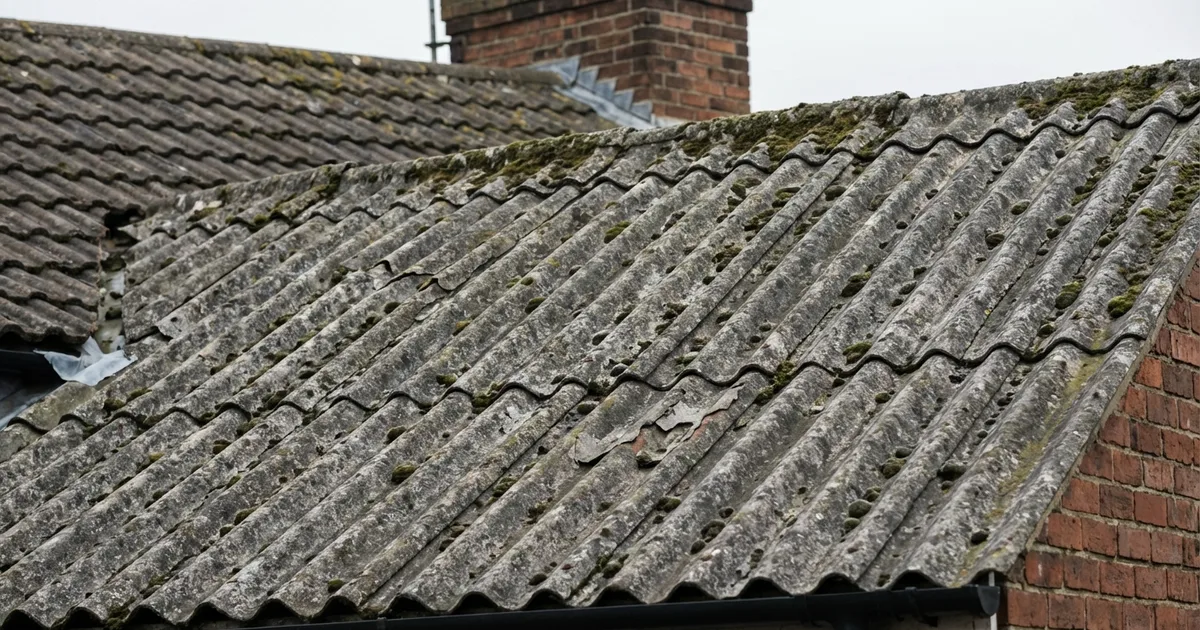
If you suspect asbestos in roof tiles on your property, the next step is a visual check. Asbestos cement tiles are typically white, grey, or bluish-white when new, fading over time to a blotchy, unnatural pale grey. The surface texture is often dimpled, cratered, or pitted. Chipped corners or broken edges will expose a grey, granular interior.
Know the two main types. Flat or profiled asbestos cement tiles were common on domestic roofs. Corrugated asbestos cement sheets, larger and ribbed, were used on garages, outbuildings, and agricultural buildings. Both contain the same material. The corrugated sheets are easier to spot because of their distinctive shape, but flat tiles are often mistaken for ordinary concrete. One reliable tell: asbestos cement tiles weigh roughly 2.5 kg each, noticeably lighter than concrete tiles at 4 kg or more. If your roof tiles feel surprisingly light and thin, that’s a strong indicator.
Check for manufacturer stamps on the underside. Some tiles were marked during production. “AC” stands for Asbestos Cement, confirming asbestos content. “NT” stands for Non-Asbestos. The problem is that only approximately 1 in 20 tiles was ever stamped. No stamp does not mean no asbestos.
The only reliable confirmation is a bulk sample sent to a UKAS-accredited laboratory. Don’t try to collect a sample yourself. Breaking or chipping an asbestos cement tile can release fibres from the freshly exposed surface. Call an accredited asbestos surveyor. They’ll take a controlled sample, send it for analysis, and give you a formal result.
Are Asbestos Roof Tiles Dangerous?
Asbestos cement is a “bonded” or non-friable material. The asbestos fibres are locked into a cement matrix and not freely released under normal conditions. Tiles in good condition, sitting undisturbed on your roof, pose minimal health risk. That’s the honest assessment.
The risk increases sharply when the condition changes. Cracked, broken, or heavily weathered tiles release surface fibres as the cement erodes. Any cutting, drilling, power washing, or abrasive work on asbestos roofing creates fibre exposure. Dropping or breaking tiles during removal does the same. Water infiltration that weakens the cement matrix accelerates the problem.
If fibres get out, the consequences are severe. Mesothelioma is virtually always fatal. HSE data records 2,218 mesothelioma deaths in Great Britain in 2023. Asbestos-related lung cancer kills an estimated 2,500 more people per year. Then there’s asbestosis and pleural thickening, both progressive and debilitating.
These diseases take 20 to 50 years to manifest after exposure. People dying today were exposed in the 1970s and 1980s. That latency is why UK asbestos deaths persist despite the 1999 ban.
A 2025 British Safety Council analysis warns of a “fourth wave” of asbestos deaths, driven by renovation work on in-situ asbestos. The risk isn’t historical. It’s current, and it’s concentrated in exactly the kind of work that disturbs old asbestos roof tiles.
The data backs this up. Female mesothelioma deaths remained stable at 416 in 2023 while male deaths have been declining. That divergence matters because it signals a population still being exposed through domestic renovation and maintenance, not the industrial workplace exposure that drove the earlier waves.
UK Law and Asbestos Roof Tiles: What Most Guides Get Wrong
The Control of Asbestos Regulations 2012 (CAR 2012) governs all asbestos work in the UK. Most consumer guides either say you always need a licensed contractor (wrong) or gloss over the distinction entirely. The reality is a three-tier system, and which tier applies determines who can legally do the work, what procedures are required, and how much the job costs.
| Category | What It Covers | Asbestos Roof Tiles? |
|---|---|---|
| Licensed Work | High-risk friable asbestos (asbestos insulating board, pipe lagging, spray coatings) | Only if tiles will be substantially broken up or damaged during removal |
| Notifiable Non-Licensed Work (NNLW) | Deteriorated or damaged material, or work above certain exposure thresholds | If tiles are significantly degraded or removal creates substantial dust |
| Non-Licensed Work | Low-intensity, sporadic work with material in reasonable condition | Standard careful removal of weathered but intact asbestos cement tiles |
What this means for your roof: standard asbestos roof tile removal is often NNLW or non-licensed work, not the most expensive licensed-contractor category. If a competent contractor removes intact asbestos cement tiles carefully, without dropping or breaking them, this typically falls outside the licensed work requirement.
That does not mean anyone can do it. Proper training, correct PPE, and legal disposal are mandatory regardless of category. The HSE’s guidance on non-licensed work sets a fibre exposure limit of 0.6 fibres/cm³ over a 10-minute period. Exceed that, and the work category changes.
This is precisely why you still need a professional assessment. Only an experienced contractor can determine on-site which category applies to your specific roof. If tiles are more degraded than they look, the category can shift mid-job. Getting this wrong is a criminal offence under CAR 2012. A contractor holding a current HSE standard asbestos removal licence can assess and handle all three categories, so there’s no risk of being caught in the wrong tier.
Disposal is non-negotiable at every tier. Asbestos waste must be double-bagged in clearly labelled asbestos waste bags and taken to a licensed hazardous waste facility. Fly-tipping asbestos is a criminal offence with unlimited fines.
Remove or Leave? A Practical Decision Framework
Leave them if:
- Tiles are in good condition with no cracks, no exposed grey interior, and no heavy erosion
- No planned works on or near the roof
- An asbestos management plan is in place (required for commercial and landlord properties under the duty to manage)
- Budget is the primary constraint and encapsulation is a viable interim option
Remove when:
- Tiles are cracked, broken, or significantly weathered
- You can’t source replacement tiles. Asbestos cement tiles are no longer manufactured, so any repair job that needs replacement tiles forces a full removal
- You’re planning a roof repair, extension, loft conversion, or full re-roof
- You’re selling the property. Asbestos presence must be disclosed during conveyancing, and many buyers request removal before exchange
- You want solar panels installed. The fixings would penetrate and disturb the asbestos cement
- The roof is approaching end of service life. Asbestos cement tiles typically last 30 to 50 years, which means tiles from the 1970s or 1980s may already be past their useful lifespan
Encapsulation as an interim option. A specialist sealant coats the tile surface and binds loose fibres. It costs roughly £30/m², compared with £60–£170/m² for full removal. It’s not a permanent fix. The tiles still need removing eventually. And it’s not suitable for badly damaged tiles where the cement has already broken down. But for a roof in fair condition where budget is tight, it buys time.
If you’re dealing with corrugated asbestos cement sheets on a garage or outbuilding rather than roof tiles, the identification and legal framework are similar but the removal process differs. See our guide to asbestos garage roof removal for that specific scenario.
Asbestos Roof Tile Removal Cost in the UK (2026 Prices)
A typical asbestos roof tile removal on a UK semi-detached house costs around £2,100. That number can halve or double depending on three things: how hard the roof is to access, how damaged the tiles are, and where you are in the country. Here are the 2026 price ranges.
| Job Type | Cost Range | Notes |
|---|---|---|
| Removal per m² | £60–£170/m² | Wider range reflects access difficulty and regional labour costs |
| Full residential roof removal | £950–£3,750 | Average ~£2,100; typical UK semi-detached roof is 30–50m² |
| Encapsulation per m² | ~£30/m² | Interim option; not suitable for damaged tiles |
| Asbestos survey (before removal) | £150–£400 | UKAS-accredited surveyor; required before licensed or NNLW work |
| Scaffolding | £500–£2,000+ | Mandatory for most pitched roofs; often quoted separately |
Roof tile removal costs more than most other asbestos removal types for three reasons. First, scaffolding or a cherry picker is required for any pitched roof, and that access equipment alone can add £500 to £2,000 to the bill. Second, working at height regulations impose additional safety requirements and slow the job down. Third, a typical residential roof generates a large volume of asbestos waste compared to, say, removing a few floor tiles or a section of insulation board.
The survey is not optional for removal work. A UKAS-accredited surveyor confirms asbestos presence, assesses tile condition, and determines which CAR 2012 category the job falls into before any contractor starts work. For a detailed breakdown of what drives survey pricing, see our guide on asbestos survey costs. For a broader view of removal costs across all asbestos types, our full asbestos removal cost guide covers everything from garage roofs to insulation board.
Always get at least three quotes from verified contractors. Price variation is significant and often legitimate, driven by access difficulty, location, and job size. The cheapest quote isn’t automatically wrong. But a quote with no mention of a survey, no reference to notification procedures, and no clear waste disposal plan is a red flag you should take seriously.
Finding a Qualified Contractor
Getting the right contractor matters more than getting the cheapest quote. Here’s how to verify them before any work starts.
For any work that could fall into the licensed or NNLW category, check the HSE’s CONIAC register to verify the contractor holds a current licence. A maintenance licence doesn’t cover full removal. An expired licence doesn’t authorise any work. And if a contractor says they can start tomorrow on a notifiable job, that’s a problem, because NNLW requires notification to the HSE before work begins.
Before any contractor starts work, ask for three things: the reference number from their asbestos survey, the CAR 2012 category they’ve assigned to the job, and their waste carrier licence number. If they can’t produce all three, find someone who can. A legitimate quote should also include their insurance certificate and a clear disposal method. After the job, demand the waste consignment notes as proof your asbestos was taken to a licensed facility, not dumped.
Search The Asbestos Register to find and verify HSE-licensed contractors in your area.