If you’re trying to spot asbestos by eye, you’re already looking for the wrong thing. Asbestos fibres are microscopic, measuring 0.1 to 10 micrometres in diameter. That’s smaller than a human hair and completely invisible without a laboratory microscope. Asbestos-related diseases still kill roughly 5,000 people a year in the UK, so getting identification right matters.
But the materials that contain asbestos? Those you can learn to recognise. And that’s what this guide is for.
Most identification guides organise by material type. This one organises by room, because that’s how you actually think when you’re standing in your house staring at a suspect ceiling or floor. If you know which room you’re in and roughly when your home was built, you can narrow down the likely asbestos-containing materials (ACMs) quickly.
An estimated 1.5 million UK buildings still contain asbestos. If your property was built or refurbished before 2000, this guide is for you.
Why You Can’t “See” Asbestos, and What You’re Actually Looking For
Individual asbestos fibres measure 0.1 to 10 micrometres across. You will never confirm asbestos visually. Only a UKAS-accredited laboratory can do that, by analysing a bulk sample under polarised light microscopy.
What visual inspection can do is identify suspect materials. The appearance, location, and age of a material can tell you whether it’s likely to contain asbestos. “Likely to contain” is the strongest statement you can make without a lab result. Visual identification means suspect or probable. Only a lab test means certain. For the step-by-step method, see our guide on how to identify asbestos.
That grey board in your airing cupboard might be AIB or might be plasterboard. Without a lab test, you cannot know. And the consequences of guessing wrong run one way: dismissing something that needs testing is far worse than being cautious about a modern material that looks similar. Learning how to spot asbestos materials is about reading context clues, not spotting fibres.
The Three Types of Asbestos Found in UK Homes
Asbestos comes in three main types. Their names refer to the colour of the raw mineral fibre, not the colour of the finished product. This is the single biggest source of confusion. Don’t rely on asbestos colours to identify what you’re looking at.
White asbestos (chrysotile) has soft, curly fibres and was used in over 90% of all asbestos products commercially. You’ll find it in artex, cement sheets, floor tiles, and roofing felt. It was the last type banned in the UK, in 1999.
Brown asbestos (amosite) has straight, brittle fibres. It’s the second most common type in UK buildings and was used in insulating boards, ceiling tiles, and fire protection boards. Banned in 1985.
Blue asbestos (crocidolite) has fine, needle-sharp fibres and is the most hazardous type. It was used in spray-on fireproofing and pipe insulation. Also banned in 1985.
Here’s the critical point: these colour names describe the raw mineral, which is never visible once mixed into a building product. A grey ceiling tile could contain white, brown, or blue asbestos. You cannot identify asbestos type by looking at a finished material.
What matters more than the type is the material it’s in and the condition it’s in. Here’s what those materials actually look like.
What Do Asbestos-Containing Materials Actually Look Like?
Artex and Textured Ceilings
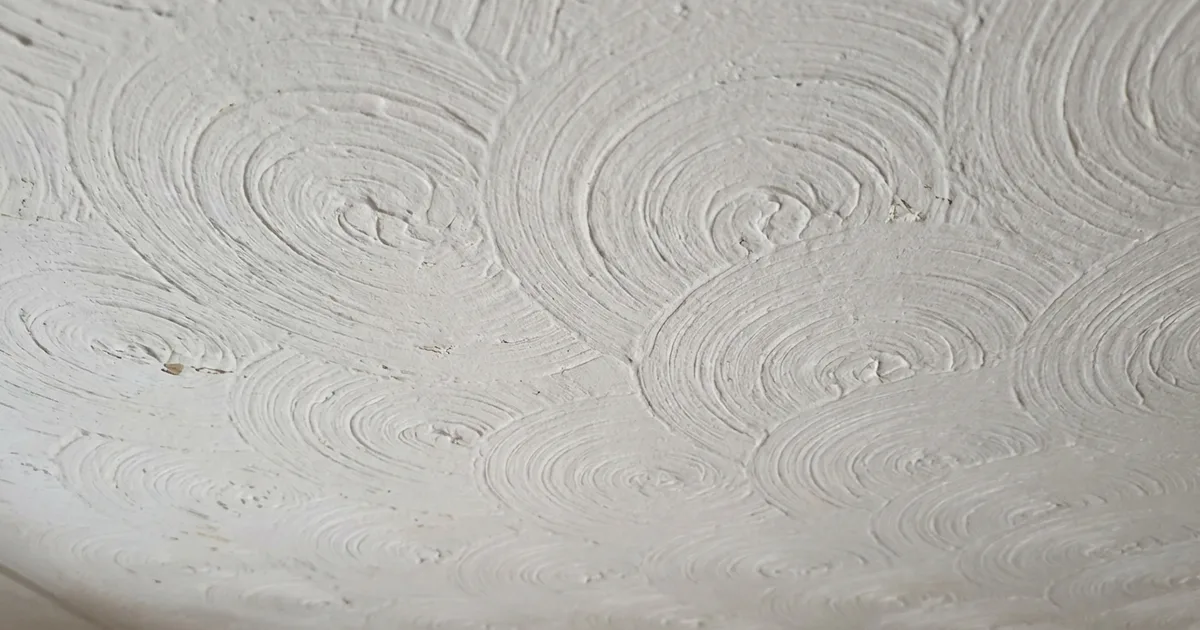
Swirly, stippled, or fan-patterned surface on ceilings. The most common patterns are combed swirls, stipple (an orange-peel texture), bark effect, and skip-trowel finishes. Colour is typically off-white to cream, often yellowed with age or painted over multiple times.
Artex made before 1984 is very likely to contain asbestos, typically 3–5% chrysotile by weight. Between 1984 and 1999, asbestos content declined but was not eliminated. Post-2000 artex is asbestos-free.
Risk is low when the surface is undisturbed. It becomes high the moment anyone sands, scrapes, or drills into it. In 1970s homes especially, artex is one of the most frequently disturbed ACMs during DIY renovations, because homeowners rarely suspect a textured ceiling could be hazardous.
Asbestos Cement Sheets (Garage Roofs, Sheds)
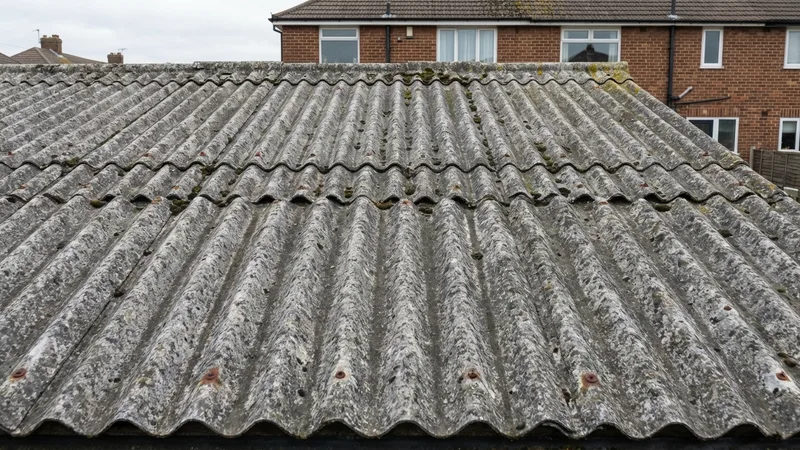
Corrugated or flat grey sheets, sometimes with a greenish tinge from weathering. Older surfaces often show a whitish bloom. Edges may appear slightly layered.
Asbestos cement contains 10–15% chrysotile bonded into a cement matrix. The corrugated garage roof from the 1970s and 1980s is the single most recognisable domestic asbestos material in the UK. You can find detailed visual reference diagrams on the HSE asbestos diagrams page.
Risk is lower when sheets are intact. It increases sharply if they’re cracked, drilled, cut with a saw, or cleaned with a pressure washer.
Asbestos Insulating Board (AIB)
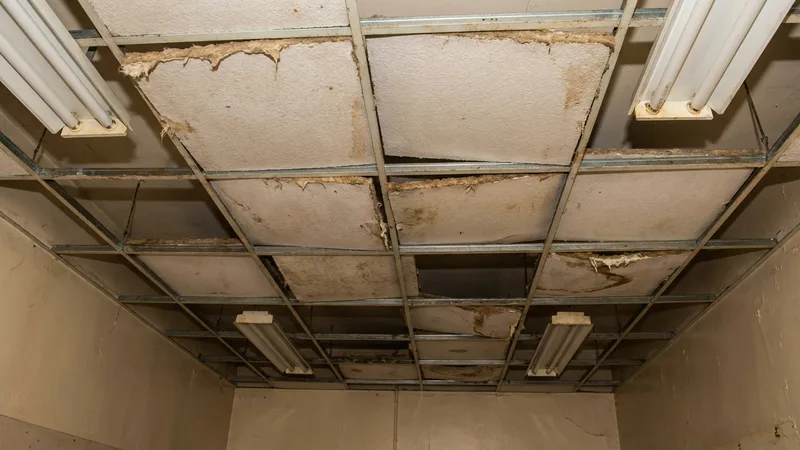
Rigid board, grey-white or light grey, with a rough, slightly porous surface. Thickness ranges from 3mm to 25mm. Ceiling tiles are usually 6 to 18mm thick.
AIB is commonly mistaken for plasterboard. The key difference: AIB has a rough, dense, cement-like texture rather than the smooth papery finish of standard plasterboard. If you have ceiling tiles in a suspended metal grid, or partition boards in a pre-2000 building that feel dense and slightly gritty, suspect AIB. Our guide to asbestos insulating board (AIB) covers what it is and where it was used.
Asbestos content runs from 16% to 35%, typically a blend of amosite and chrysotile. This is the highest concentration of any common ACM. AIB is classified as a licensed removal material. Drilling, cutting, or sanding it releases large quantities of fibres. Removal requires an HSE standard asbestos removal licence.
Floor Tiles
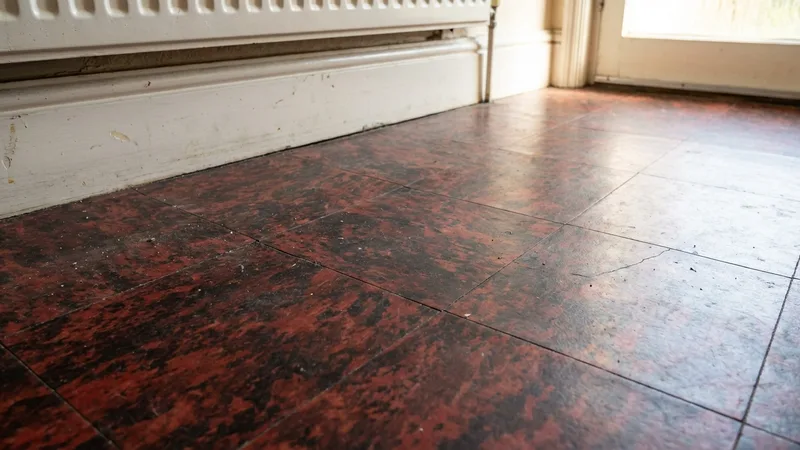
Vinyl floor tiles in a 9×9 inch (22.5×22.5cm) format. That imperial sizing is the strongest visual clue. Modern tiles are metric, typically 30×30cm.
Common colours include dark red, black, brown, cream, grey, and multi-coloured patterns. The surface is hard and smooth but the tiles are brittle and prone to cracking, unlike modern flexible vinyl. You’ll find them in kitchens, bathrooms, and hallways in properties built between the 1950s and 1980s.
Both the tile and the bitumen adhesive beneath it may contain asbestos. Risk is low when tiles are intact. It becomes high if tiles are cracked, sanded, or removed by grinding. For more detail on testing and removal options, see our guide to asbestos floor tiles.
Pipe Lagging and Thermal Insulation
White or grey material wrapped around old boiler pipes and heating pipes. It may have a smooth outer coating or tape finish. Older lagging is often crumbling, cracked, or flaking at the edges. Found in airing cupboards, cellars, and loft spaces, typically around old boilers and heating systems installed before 1980.
Pipe lagging is friable, meaning fibres release easily with minimal disturbance. If the lagging around your pipes is soft, dusty, or crumbling, do not touch it. This is high-risk material that requires a licensed contractor.
Loose Fill Insulation
Fluffy, blue-grey or white fibrous material resembling candyfloss or dense loft insulation. Found in cavity walls and loft floors, primarily in 1960s and 1970s local authority housing.
This is the most dangerous form of asbestos found in domestic settings. It contains pure or near-pure asbestos fibres that are readily airborne. If you open a wall cavity or loft and see unusual blue-grey fluffy material, leave the room immediately. Do not touch it. Call a licensed specialist.
How to Spot Asbestos Room by Room in a UK Home
Nobody walks into their kitchen thinking about chrysotile content. You notice the floor tiles look old and brittle, or the ceiling has that swirly texture you’ve seen in every 1970s house. So instead of organising by material type, here’s where to look, room by room.
| Location | What to look for | Risk if disturbed |
|---|---|---|
| Garage or shed roof | Corrugated grey cement sheets | Medium |
| Bedroom, hall, or lounge ceiling | Artex swirl or stipple texture | Low–Medium |
| Suspended ceiling tiles | Dense grey tiles in a metal grid | High |
| Partition walls and fire doors | Rigid grey-white boards (AIB) | High |
| Airing cupboard or boiler room | White/grey lagging on pipes, AIB panels | High |
| Kitchen or bathroom floor | 9×9 inch vinyl tiles in dark or mottled colours | Low–Medium |
| Loft (ex-council housing) | Blue-grey fluffy loose fill insulation | Extreme |
| Cold water tank | Grey cement box or panel | Low |
| Flue pipes and soffit boards | Grey cement pipes or flat boards | Low–Medium |
Start with the garage. If you have a corrugated grey roof on your garage or shed, that’s the most common asbestos material in UK homes. Move inside to the ceilings. Swirly artex in the bedroom or lounge? If the house pre-dates 1985, assume it contains asbestos until tested.
The airing cupboard is the one most people forget. Open the door and look at the pipes. White or grey wrapping that’s crumbling at the edges is a red flag. And if you’re in an ex-council property from the 1960s or 1970s, check the loft before doing any work up there. Loose fill insulation, the blue-grey fluffy material, is the most dangerous form of domestic asbestos.
Not every room carries equal risk. The airing cupboard, partition walls, and any suspended ceiling tiles deserve more caution than an intact garage roof or undamaged floor tiles. If you’re in London or the North West, where pre-1980 housing stock is particularly dense, these are the locations you’ll encounter most often.
When Was Your Home Built? The Age-of-Risk Guide
If you know roughly when your home was built, you already have the most useful risk indicator. Check your title deeds, the property listing, or your local council’s planning records. A decade is close enough.
| Build era | Risk profile |
|---|---|
| Pre-1945 | Asbestos possible in pipe lagging and insulation. Asbestos cement uncommon. |
| 1945–1965 | Highest risk. All three types used extensively during the post-war construction boom. |
| 1965–1980 | Still very high risk. Textured coatings widespread, AIB commonly used. |
| 1980–1999 | Blue and brown asbestos banned from 1985. White asbestos (chrysotile) still in use until 1999. Artex remains a risk throughout. |
| Post-2000 | New builds are asbestos-free. Any pre-2000 element (extension, refurbishment) can still carry risk. |
The anchor point: any UK property built or refurbished before 2000 may contain asbestos. Properties built between 1945 and 1985 carry the highest risk, because all three types of asbestos were used freely throughout that period.
The peak risk window is 1945 to 1985. The post-war construction boom used asbestos in almost everything: cement sheets, insulating boards, textured coatings, floor tiles, pipe lagging. If your property dates from this era, treat every suspect material as containing asbestos until a lab test says otherwise.
Friable vs Non-Friable: What Actually Determines Your Risk Level
Whether asbestos is dangerous depends less on what type it is and more on its physical condition. The technical term is friability: how easily the material crumbles and releases fibres into the air.
Non-friable (bonded) materials have asbestos fibres locked tightly into a cement or resin matrix. While they remain intact and undamaged, they present low risk. Examples: asbestos cement sheets, intact floor tiles, undamaged artex.
Friable materials have loosely bound fibres that become airborne with minimal disturbance. Examples: loose fill insulation, crumbling pipe lagging, spray-on coatings, damaged AIB.
The practical rule: condition beats material type. An intact asbestos cement roof is lower risk than crumbling pipe lagging. A perfect artex ceiling is lower risk than a damaged AIB panel. Friable materials require a licensed contractor under the Control of Asbestos Regulations 2012 (CAR 2012). It is a criminal offence to carry out licensable removal work without an HSE licence.
Stop Before You Start: What NOT to Do if You Suspect Asbestos
These are the most common mistakes that release asbestos fibres, often without anyone realising until well after the fact.
- Do not sand or dry-scrape artex ceilings. This is the single most common accidental exposure event in UK homes.
- Do not drill through partition boards or ceiling tiles to hang shelves or light fittings.
- Do not pressure-wash a corrugated garage roof or shed.
- Do not saw, grind, or cut asbestos cement sheets.
- Do not break or crumble old floor tiles to remove them by hand.
- Do not disturb unusual loft insulation without having it tested first.
If you’ve already done any of these, stop, ventilate the area, and get the material tested. The HSE advises stopping work immediately and having the material sampled before continuing. You need to know what you’ve disturbed before doing anything else.
What to Do Next: A Three-Step Decision Framework
You’ve spotted something and left it alone. Now follow these three steps.
Step 1: Stop and Assess Condition
Is the material intact, stable, and in good condition? If yes, the risk is lower. You can monitor it and leave it undisturbed.
Is it crumbling, cracked, powdering, or visibly damaged? If yes, do not touch it. Move to Step 3 immediately.
Step 2: Decide Whether to Manage or Test
If the material is intact and in a location you won’t disturb, you may choose to leave it in place with a management plan. Many homeowners live safely alongside intact ACMs for decades.
If you have any doubt about its condition, or if you’re planning renovation work nearby, commission an asbestos survey. A management survey for a standard 3-bed house typically costs £200–£350. Only UKAS-accredited laboratories can confirm asbestos through bulk sampling, and a licensed surveyor takes the sample safely under controlled conditions.
Step 3: Find a Licensed Contractor
For confirmed asbestos, removal of AIB, thermal insulation, and sprayed coatings requires a contractor holding a current HSE standard asbestos removal licence. Some lower-risk work, such as removing intact asbestos cement, may fall under a maintenance licence. Either way, it is a criminal offence to carry out licensable work without the correct licence.
Search The Asbestos Register to find HSE-licensed contractors and surveyors verified against the official CONIAC register. You can filter by region and compare ratings, reviews, and licence types. If you’re in Kent, for example, see our page on the best asbestos removal contractors in Kent to compare verified options in your area.
Frequently Asked Questions
Can I tell if something contains asbestos just by looking at it?
No. Asbestos fibres are microscopic and completely invisible to the naked eye. Visual inspection can only identify materials that are likely to contain asbestos based on their appearance, location, and the age of the building. The only way to confirm asbestos is through laboratory testing of a bulk sample taken by a qualified professional.
What colour is asbestos?
The three main types have informal colour names: white (chrysotile), brown (amosite), and blue (crocidolite). But these refer to the raw mineral fibre, which is never visible in finished building products. In artex, cement sheets, floor tiles, or insulating boards, the asbestos fibres are mixed into the host material and have no visible colour. Don’t try to identify asbestos by colour in a building material.
My house was built in the 1970s. Should I assume it has asbestos?
Any UK property built or refurbished before 2000 may contain asbestos, but properties built between 1945 and 1985 carry the highest risk. A 1970s home is very likely to have textured ceilings (artex), asbestos cement outbuildings, and potentially AIB partition boards. Treat any suspect material as potentially containing asbestos until tested.
Is artex always asbestos?
Artex made before 1984 is very likely to contain asbestos, typically 3–5% chrysotile by weight. Between 1984 and 1999, asbestos use declined but was not fully eliminated, so artex from that period may or may not contain it. Post-2000 artex products are asbestos-free. If you’re unsure, have it sampled by an accredited laboratory before sanding or scraping.
Do I need a licensed contractor to remove asbestos?
It depends on the material. AIB, thermal insulation, and sprayed coatings require an HSE-licensed contractor. It is a criminal offence to carry out this work without a licence under the Control of Asbestos Regulations 2012. Asbestos cement and intact floor tiles can be removed without a licence under strict controls. Use The Asbestos Register to find HSE-licensed contractors verified against the official CONIAC register.