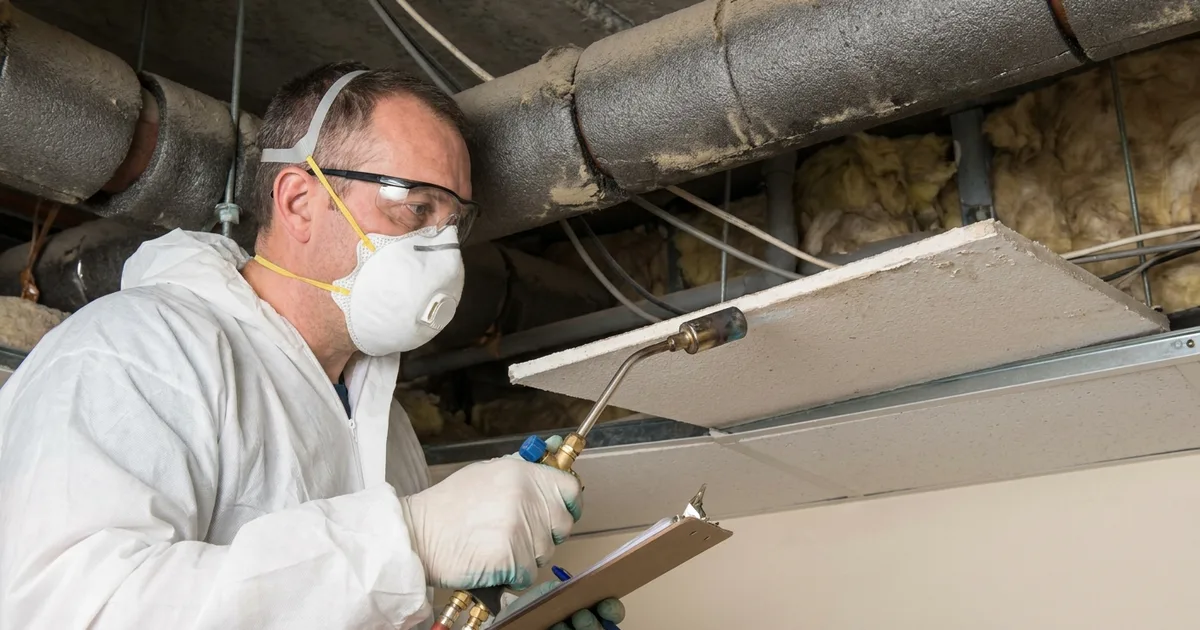
Most questions about asbestos surveys focus on the wrong thing. “Which type do I need?” matters, but it’s what comes after the survey that creates the legal exposure. Get it wrong and you’re looking at an unlimited fine and up to two years’ imprisonment for the most serious cases. This is criminal law, not a civil dispute.
The reason is simple. A building owner who commissions an asbestos survey hasn’t discharged a duty. They’ve started one that runs for the life of the building. The report that lands on your desk is a legal document with obligations attached, and the Health and Safety Executive prosecutes failures to meet them as criminal matters.
This guide covers the full arc. Not just the two survey types, but who is legally required to have one, what the process actually involves, what the report commits you to, the penalties for ignoring it, realistic costs to budget for, and how to confirm a surveyor is genuinely accredited before you hire them.
What is an asbestos survey?
An asbestos survey is a formal inspection by a qualified professional to identify, locate, and assess the condition of asbestos-containing materials (ACMs) in a building. It produces an asbestos register, condition ratings, and management recommendations. It is not a yes-or-no answer. It is a record of what is present, where, and what you need to do about it.
This isn’t a niche problem. The HSE estimates around 500,000 non-domestic buildings in the UK still contain asbestos, and up to 1.5 million homes are likely to contain it. One 2022 analysis found asbestos present in 78% of the building surveys it reviewed. Asbestos is linked to roughly 5,000 deaths a year, still the single largest cause of work-related death in the country.
Any building constructed or refurbished before the year 2000 may contain ACMs. If your property predates the millennium, the question isn’t whether asbestos might be there. It’s whether you’ve identified it. The survey process depends entirely on which type is required, and that depends on what the building is being used for.
Management Survey vs Refurbishment and Demolition Survey: Which Do You Need?
There are two survey types under HSG264, the HSE reporting standard. They are not interchangeable, and most duty holders need one specific type.
An asbestos management survey (the Type 2 survey) is non-intrusive or minimally intrusive. The building can stay occupied throughout. Its purpose is to find ACMs that could be disturbed during normal occupation, maintenance, and routine activity. The output is an asbestos register plus a management plan. If you own or occupy a non-domestic building built before 2000 and there’s no existing survey in place, this is the survey you need before occupation continues.
A refurbishment and demolition survey (the Type 3 survey, also called an asbestos refurbishment survey) is fully intrusive and destructive. The surveyed area has to be vacated. Its job is to find every ACM before work starts, including the ones hidden in voids, cavities, and service shafts, and it samples every suspect material to do it. Under the Control of Asbestos Regulations 2012 (CAR 2012), this survey is required before any refurbishment or demolition work begins. Skip it and you’re working blind in a building that may be full of asbestos.
The decision rule is straightforward. If the building is occupied and you’re not planning structural works, you need a management survey. If any refurbishment, alteration, or demolition is planned, you need an R&D survey for the affected area, even if a management survey already exists. The R&D survey supersedes the management survey for the area it covers, and a single building will often need both types at different points in its life.
Whether or not a survey is legally required depends on your role in the building, and the law is specific about who that applies to.
Who Is Legally Required to Have an Asbestos Survey?
Regulation 4 of CAR 2012 sets out the duty to manage asbestos in non-domestic premises. It applies to owners and occupiers of offices, retail units, warehouses, factories, schools, hospitals, and the common areas of residential blocks. If you searched for who needs an asbestos survey in the UK, this regulation is almost certainly your answer.
You are a duty holder if you are a commercial landlord, a landlord responsible for the common areas of a residential block, an employer occupying premises, a building owner, or a facilities manager responsible for maintenance. The obligation is to identify all ACMs, or presume their presence and manage accordingly. A management survey is how virtually every duty holder discharges that duty.
Private homes are different. A private homeowner is not covered by Regulation 4 and does not legally need a survey before routine maintenance, though they must not disturb suspected ACMs. The exception is renovation. Under the Construction (Design and Management) Regulations, an R&D survey is required before any refurbishment or demolition works, even on a domestic property.
The bottom line: if you manage a non-domestic building built before 2000, Regulation 4 applies to you, and a management survey is how you comply. Once it’s clear a survey is needed, the next question is what actually happens on site.
What Happens During an Asbestos Survey, Step by Step
Most duty holders have never watched a survey happen, so it helps to know what you’re paying for and how much disruption to expect. An asbestos inspection runs through five stages.
1. Scoping. The surveyor reviews building plans where available, agrees the scope of works with you, and confirms which survey type is required.
2. Site visit and inspection. The surveyor inspects all accessible areas, photographs suspect materials, and records their location and condition. For a management survey the building stays occupied. For an R&D survey the area must be vacated.
3. Sampling. Representative bulk samples are taken from suspect ACMs. Management surveys use selective sampling of accessible materials. R&D surveys sample comprehensively, including materials hidden in voids, cavities, and service shafts.
4. Laboratory analysis. Samples go to a UKAS-accredited laboratory for fibre identification, using polarised light microscopy or transmission electron microscopy.
5. Report production. The formal report, written to the HSG264 standard, contains the asbestos register (location, type, extent, and condition of every ACM), floor plans annotated with ACM locations, condition and risk ratings via a Priority Assessment Score, management recommendations (leave in place, monitor, repair, encapsulate, or remove), and photographs.
The report is not just a list. It is a legal document that duty holders must keep on site and make available to every contractor before any works begin. The report is where many duty holders stop, but that’s where the legal obligations begin.
What You’re Legally Required to Do After the Survey
The survey creates ongoing duties, not a one-off tick in a box. This is the part that matters most to a duty holder, and it’s where most people come unstuck.
Keep the asbestos register on site. It must be available on the premises at all times. Every contractor (plumber, electrician, builder) must be shown it before any work begins. Failing to do so is a compliance breach in its own right.
Produce a management plan. The duty holder must build an asbestos management plan from the survey report, setting out how each ACM will be managed: condition monitoring, access controls, and a remediation timeline. It must be reviewed regularly and updated whenever conditions change.
Run a re-inspection schedule. ACMs in good condition must be re-inspected every 6 to 12 months. Damaged or deteriorating materials need checking more often. This is an ongoing cost to budget for, not a single payment.
Act on remediation triggers. ACMs rated high-risk for disturbance should be removed by an HSE-licensed contractor before any work happens in that area. For licensable removal you’ll need HSE standard licence holders, while lower-risk maintenance work may fall to maintenance licence holders. The survey output can become a removal instruction.
Notify the HSE where required. Certain licensable works, such as removing asbestos insulating board, sprayed coatings, or lagging, require advance notification to the HSE using the ASB5 form (the HSE’s notification of licensable asbestos work), with a minimum of 14 days’ notice. The penalties for ignoring these obligations are not theoretical. The HSE actively prosecutes.
What Non-Compliance Actually Costs
The regime here is criminal, not civil, and the stakes are higher than most duty holders realise.
The fine is unlimited, whether the case is heard at magistrates’ court or Crown Court. Serious cases carry up to two years’ imprisonment. The HSE can also serve enforcement notices: an improvement notice requiring you to fix a failing within a set timeframe, or a prohibition notice stopping work immediately.
The HSE treats duty-to-manage failures as criminal offences. This is not a regime where you pay a small penalty and move on. With the legal picture clear, the practical question becomes what this costs and how you find someone qualified to do it.
How Much Does an Asbestos Survey Cost?
Survey costs are driven by what’s being surveyed, not a fixed price list, so treat the figures below as budgeting benchmarks rather than quotes. Every building is different, but these ranges will tell you whether a quote is sensible or whether someone’s cutting corners.
| Property type | Typical cost range | Notes |
|---|---|---|
| Small flat / 1-bed | £180 to £250 | Management survey, basic inspection |
| 3-bed house | £220 to £380 | Management survey, 5 to 8 samples |
| Large house (5+ bed) | £350 to £480 | Management survey |
| Small commercial unit | £495 to £700 | Half-day survey |
| Large commercial premises | £700 to £2,000+ | Multi-day, complex access |
| R&D survey (residential) | £300 to £600 | More intrusive, more samples |
| R&D survey (commercial) | £800 to £2,500+ | Comprehensive, often multi-day |
Cost is driven by property size, the number of samples required, access difficulty, and location. London licensed asbestos contractors and South East licensed contractors typically carry a regional premium over the rest of the UK. Survey type matters too: an R&D survey costs more than a management survey because it’s fully intrusive and destructive, takes more samples, requires the area to be vacated, and produces a more complex report. Express lab turnaround adds to the bill as well.
Treat these asbestos survey ranges as a starting point for budgeting. Cost varies, but the qualifications of the person doing the survey should not.
How to Find a UKAS-Accredited Asbestos Surveyor
The surveying body must be UKAS-accredited under ISO 17020, the standard for inspection bodies. UKAS (the United Kingdom Accreditation Service) is the sole recognised accreditation body in Great Britain for asbestos inspection. You can verify a firm through the UKAS directory.
Individual surveyors should hold the P402 qualification (Asbestos Surveying and Sampling) from the British Occupational Hygiene Society, or an equivalent. Always ask for the surveyor’s UKAS certificate number before you commission anything. A legitimate surveyor provides it without hesitation. If you want to confirm your duty under Regulation 4, the HSE’s duty to manage asbestos page is the authoritative reference.
Asbestos Register UK lists HSE-licensed asbestos contractors verified against the official CONIAC register. Search by region or county, or use our asbestos surveyor finder, to find accredited professionals near you, with ratings, reviews, and contact details, then check the credentials before any work starts.