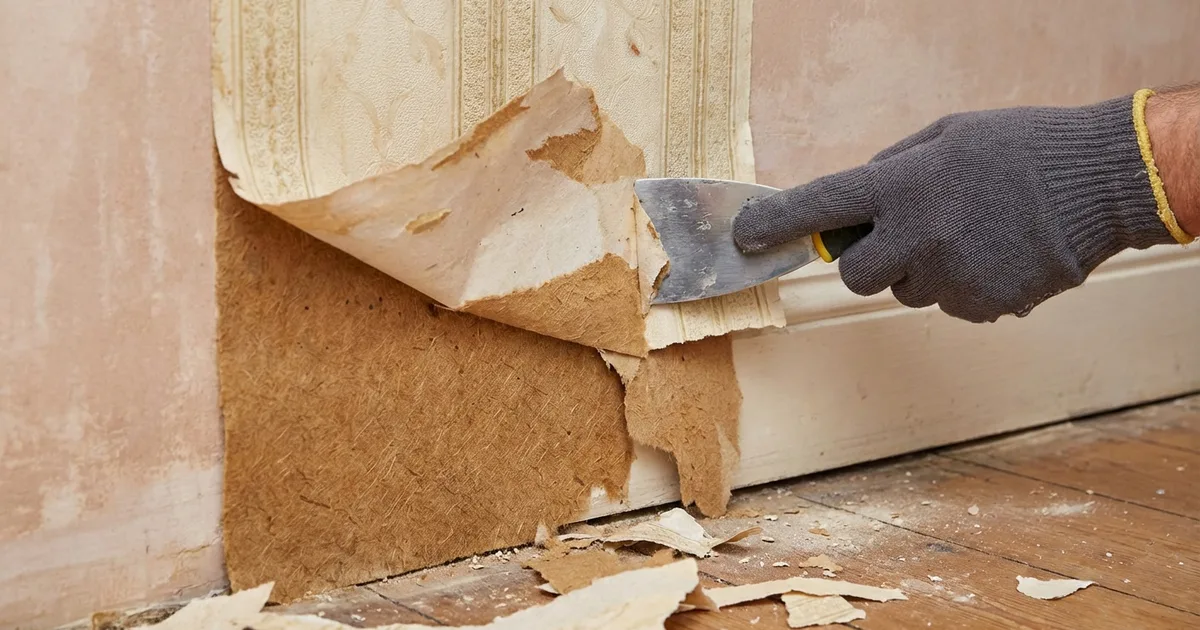
You’ve stopped stripping. Something about the backing layer, maybe it’s grey and fibrous, maybe it just doesn’t look right, has made you put down the steamer. Good. That instinct is correct.
If your home was built before 2000, there is a real chance that asbestos wallpaper is what you’re looking at. Not a certainty, but a real chance. Asbestos was used in wallpaper products from the 1930s onward, with the heaviest use before 1980. The complete UK ban didn’t come until 1999. Over 1.5 million UK buildings still contain asbestos-containing materials (ACMs) of some kind.
The good news: a single brief disturbance does not mean you have caused yourself serious harm. Asbestos-related diseases develop from repeated or prolonged exposure, not from one afternoon of stripping. But what you do in the next ten minutes matters. Stop what you are doing and read the next section before you touch anything else.
If You’ve Already Disturbed the Wallpaper, Do This Now
Stop stripping immediately. Do not continue pulling, scraping, or steaming any more material from the wall. Every additional disturbance releases more fibres into the air.
Do not vacuum the room. A standard domestic vacuum cleaner does not capture asbestos fibres. It blows them straight through the filter and back into the air, spreading contamination further. Only HEPA-filtered vacuum cleaners rated for asbestos are appropriate, and you almost certainly don’t own one.
If you can see loose material, dust, or debris on the floor or surfaces, lightly mist the area with water from a spray bottle. Dampening binds loose fibres and reduces the amount that becomes airborne. It does not eliminate the risk, but it reduces it.
Leave the room and close the door. If you can, open a window in that room before you leave to allow ventilation, but close internal doors to prevent fibres spreading to the rest of the house. Keep children and pets out.
Do not sweep, bag, or try to clean up the material yourself. Do not touch it again until you have a test result confirming whether it contains asbestos. The next step is arranging a UKAS-accredited bulk sample analysis, which is straightforward and costs less than most people expect.
A single afternoon of wallpaper stripping is not the same as years of occupational exposure. That distinction matters.
But asbestos fibres lodge permanently in lung tissue. They cannot be removed once inhaled. Over a latency period of 10 to 50 years, they can cause mesothelioma, asbestosis, and lung cancer. Around 5,000 people die from asbestos-related illness in the UK every year. That is a reason to stop now and find out what you’re dealing with.
The Three Places Asbestos Hides in Wallpaper
Most guides treat asbestos wallpaper as one thing. It isn’t. There are three distinct locations where asbestos can be present in a wallpaper system, and each carries a different risk level.
The wallpaper itself
Asbestos was woven directly into the paper or vinyl substrate of some wallpapers, particularly pre-1980 vinyl wipe-clean papers and decorative papers designed for kitchens and bathrooms. While the paper remains intact on the wall, the fibres are bound into the material and present minimal risk. The danger begins when you strip, tear, or soak it.
The backing paper or lining layer
Beneath the decorative top sheet, many walls have a separate backing or lining layer. This plain-looking paper was often treated with asbestos as a fire retardant. Homeowners stripping the decorative layer frequently don’t realise the plain layer underneath is the riskier material. It looks like ordinary lining paper. It behaves very differently when disturbed.
The adhesive paste
This is the one almost nobody thinks about. Some wallpaper adhesives manufactured before 1980 used asbestos as a filler. Once dried, this paste becomes friable, meaning it crumbles easily when touched or scraped. Friable material is the most likely to release fibres into the air during a DIY strip. When a homeowner calls a contractor about asbestos wallpaper, they almost never mention the paste. But the paste is often the component that poses the greatest risk, precisely because it is the most easily disturbed.
Which Asbestos Wallpaper Types Are Most at Risk
The date your wallpaper was installed is the single most useful indicator. The highest concentration of asbestos wallpaper was produced before 1980. Between 1980 and 1999, usage dropped sharply but did not stop entirely. Asbestos was completely banned in the UK in 1999. If your wallpaper was installed after 1999, asbestos is very unlikely unless someone reused old stock.
Vinyl wipe-clean wallpaper carries the highest risk. These thick, waterproof papers were standard in pre-1980 kitchens and bathrooms. If you have old vinyl wallpaper in a wet room of a pre-1980 property, treat it as suspect until tested.
Then there is Anaglypta, the British embossed paper brand produced by manufacturers including Turner & Newall and Cape Asbestos. Some Anaglypta products used asbestos fibre to reinforce the raised pattern. Not all Anaglypta contains asbestos, but the association with known asbestos manufacturers means pre-1980 Anaglypta should always be tested before removal.
Woodchip wallpaper is the one that catches people off guard. Many homeowners assume woodchip is nothing more than paper and wood shavings. Some pre-1980 woodchip papers incorporated asbestos fibres for fire resistance. That assumption is not always correct.
Plain lining paper used as a base coat under decorative papers can also contain asbestos. It is often ignored during decorating because it looks like the most harmless thing on the wall. If you suspect it might contain asbestos, strip the decorative paper and leave the lining in place until you get a test result.
Finally, textured heavy papers with thick, raised patterns are more likely to have been manufactured with asbestos reinforcement. The thicker and heavier the paper, the higher the probability of asbestos content in pre-1980 products.
UK manufacturers historically documented as producing asbestos wallpaper include Turner & Newall, Cape Asbestos, Ferodo Limited, and Marinite Co. If your wallpaper dates from the era when these companies were active, testing is the only way to rule asbestos out.
Woodchip and Anaglypta: The Two Wallpapers Everyone Asks About
Two named wallpaper types come up constantly in UK homes built before 2000, so let’s deal with them directly.
Woodchip wallpaper. Standard woodchip is exactly what it sounds like: small wood chips sandwiched between two layers of paper. The chips themselves are not asbestos, and most woodchip on UK walls is asbestos-free. But “most” is doing heavy lifting in that sentence. Some pre-1980 textured papers were manufactured with asbestos fibre in place of, or alongside, wood chips — and you cannot tell the difference by looking, because the chips and the fibres are both buried inside the paper. More commonly, the problem isn’t the woodchip at all: it’s the backing layer or the adhesive paste underneath it, either of which can contain asbestos regardless of what the face paper is made of. Woodchip was also the go-to cover-up paper for decades, which means it is frequently hung directly over older asbestos-containing surfaces.
Anaglypta. Anaglypta is an embossed paper and cotton product, and the brand’s papers are not an asbestos product. If the paper on your wall really is Anaglypta, the paper itself is not the concern. The concern is everything around it: asbestos-containing paste used to hang it, an older asbestos lining paper left underneath it, or a textured asbestos coating that someone papered over rather than removed. A brand name on the face layer tells you nothing about the three layers behind it.
The practical rule for both is the same as for any pre-2000 wall covering: don’t strip first and wonder later. A UKAS-accredited bulk sample test settles the question for less than the cost of a decorator’s day rate, and it tests the full sandwich — face paper, backing, and paste — not just the layer you can see.
Visual Warning Signs, and Why They Can’t Confirm Anything
Certain characteristics raise the likelihood that old wallpaper contains asbestos. Look for:
- A thick, heavy vinyl texture that doesn’t tear cleanly
- A grey or fabric-like fibrous backing layer visible at edges or where the paper has been disturbed
- Multi-layer construction that becomes apparent when corners lift
- Crumbling adhesive that appears fibrous when dry
- Installation in a kitchen or bathroom of a pre-1980 property
Any combination of these signs warrants testing. But visually “normal” wallpaper can still contain asbestos. A plain-looking lining paper can contain it. A standard-looking paste can contain it. You cannot confirm that wallpaper is safe by looking at it, no matter how experienced you are. (For the visual signatures of other common household ACMs, see our guide to what asbestos looks like.)
The only way to confirm the presence or absence of asbestos is UKAS-accredited bulk sample analysis using polarised light microscopy. Do not try to identify asbestos yourself by pulling fibres apart or examining samples without proper PPE. Under the Control of Asbestos Regulations 2012 (Regulations 20 and 21), any laboratory carrying out asbestos analysis must hold UKAS accreditation to ISO/IEC 17025.
Getting It Tested: What a UKAS-Accredited Analysis Involves
A DIY bulk sample kit is the simplest starting point. You collect a small, coin-sized sample of the suspect material, seal it in the bag provided, and post it to a UKAS-accredited laboratory. Results typically come back within 24 to 48 hours. Cost: approximately £25 to £50 per sample. For most homeowners who have spotted something suspicious and want a quick answer, this is the right first step.
The laboratory uses polarised light microscopy to identify whether asbestos fibres are present. You do not need to understand the method. What matters is that the result is definitive: the sample either contains asbestos or it does not.
If you need a more comprehensive assessment, perhaps because you’re planning a full renovation or selling the property, an asbestos surveyor will visit your home, take professional samples under controlled conditions, and produce a written survey report. This report documents all ACM locations, their condition, analysis results, and a management or removal recommendation. It is more expensive than a postal kit — our asbestos survey cost guide covers the prices — but the documentation is useful for property sales and for briefing the contractor who will do the removal work.
You can verify that a laboratory or surveyor holds UKAS accreditation by searching the UKAS directory. Do not use a lab that cannot show current accreditation. The legal requirement exists for a reason.
Licensed Removal vs DIY: What the HSE Rules Actually Say
The Health and Safety Executive draws a clear line between licensed and non-licensed asbestos work. Where your wallpaper falls on that line depends on the fibre type, the condition of the material, and the scope of the job.
Non-licensed work covers lower-risk ACMs. Under HSE Asbestos Essentials guidance, trained individuals can handle small areas of bonded (non-friable) asbestos-containing material using correct controls and procedures. If your wallpaper is in good condition, firmly bonded to the wall, and only covers a small area, it may fall into non-licensed territory. But you need a professional assessment to confirm this.
Licensed work is required for higher-risk ACMs. Friable material that crumbles when touched. Material in poor condition. Large areas. Any situation where significant fibre release is likely. A contractor holding a current HSE standard licence must carry out this work. For smaller-scope or maintenance-related jobs, a maintenance licence may apply.
Here is where wallpaper gets complicated. The paper on the wall might be non-friable and in reasonable condition. But the adhesive paste underneath, once it dries out and starts crumbling, is friable. That changes the risk category of the entire job. Do not assume wallpaper falls into non-licensed territory without a professional assessment first. The paste is often the component that pushes the work into the licensed category.
It is a criminal offence to carry out licensable asbestos work without an HSE licence. This is not a guideline or a recommendation. It is a legal requirement under the Control of Asbestos Regulations 2012, and enforcement is taken seriously.
How to Find an HSE-Licensed Asbestos Wallpaper Contractor Near You
The HSE maintains a public register of every licensed asbestos contractor in the UK. There are over 700 licensed companies, so there is no shortage of legitimate options wherever you are. Verifying a contractor’s licence takes two minutes.
Checkatrade, MyBuilder, and other generic trade directories do not filter by asbestos licence. A contractor listed on those platforms may not be qualified or licensed for asbestos work. For something with this level of legal and health consequence, verify through the official register.
The Asbestos Register lists all HSE-licensed contractors with their licence type (standard or maintenance), filterable by region and county. Every listing is verified against the CONIAC register. You can find licensed contractors in your region and compare their details before making a single phone call.
You’ve stopped the work. You know what to test for. Now you need a contractor who is licensed to do the removal legally and safely. Search the full register of HSE-licensed asbestos contractors to find one verified against the HSE list in your area.
Frequently Asked Questions
Does woodchip wallpaper contain asbestos?
Standard woodchip wallpaper is wood fibre sandwiched between paper layers — the chips themselves are not asbestos. But you cannot rule asbestos out by eye: some pre-1980 textured papers used asbestos fibre instead of wood chips, the backing layer and adhesive paste can contain asbestos regardless of the paper type, and woodchip is often painted over older asbestos-containing surfaces. If the wall pre-dates 2000, a UKAS-accredited bulk sample test is the only way to be sure.
Does Anaglypta wallpaper contain asbestos?
Anaglypta itself is an embossed paper/cotton product and the brand’s papers are not an asbestos product. The risk sits around it: asbestos-containing adhesive paste, an older asbestos backing paper underneath, or a textured asbestos coating that has been wallpapered over. In pre-2000 homes, test before stripping rather than relying on the brand name.
What does asbestos wallpaper look like?
There is no reliable visual signature. Warning signs include a grey or white fibrous backing layer, a thick heavy paper from a pre-1980 property, and paste residue that looks chalky or fibrous — but none of these confirm or rule out asbestos. Laboratory analysis of a bulk sample is the only definitive identification.
What is asbestos lining paper?
Asbestos lining (backing) paper was used from the 1930s onward as a wall liner and as the backing layer of decorative papers, with heaviest use before 1980. It is often more dangerous than the decorative face paper because stripping tears and abrades it directly, releasing fibres. If you find a grey fibrous liner under old wallpaper, stop and get it tested.
How dangerous is asbestos wallpaper?
While it stays intact on the wall, asbestos wallpaper poses minimal risk — the fibres are bound into the paper, backing, or paste. The danger comes from disturbance: stripping, steaming, sanding, or scraping releases fibres into the air, and the dried adhesive paste is often the most easily crumbled component. A single brief disturbance is very unlikely to cause harm — asbestos disease is linked to repeated exposure — but there is no officially safe threshold, so stop work, don’t re-disturb it, and get a bulk sample tested.